
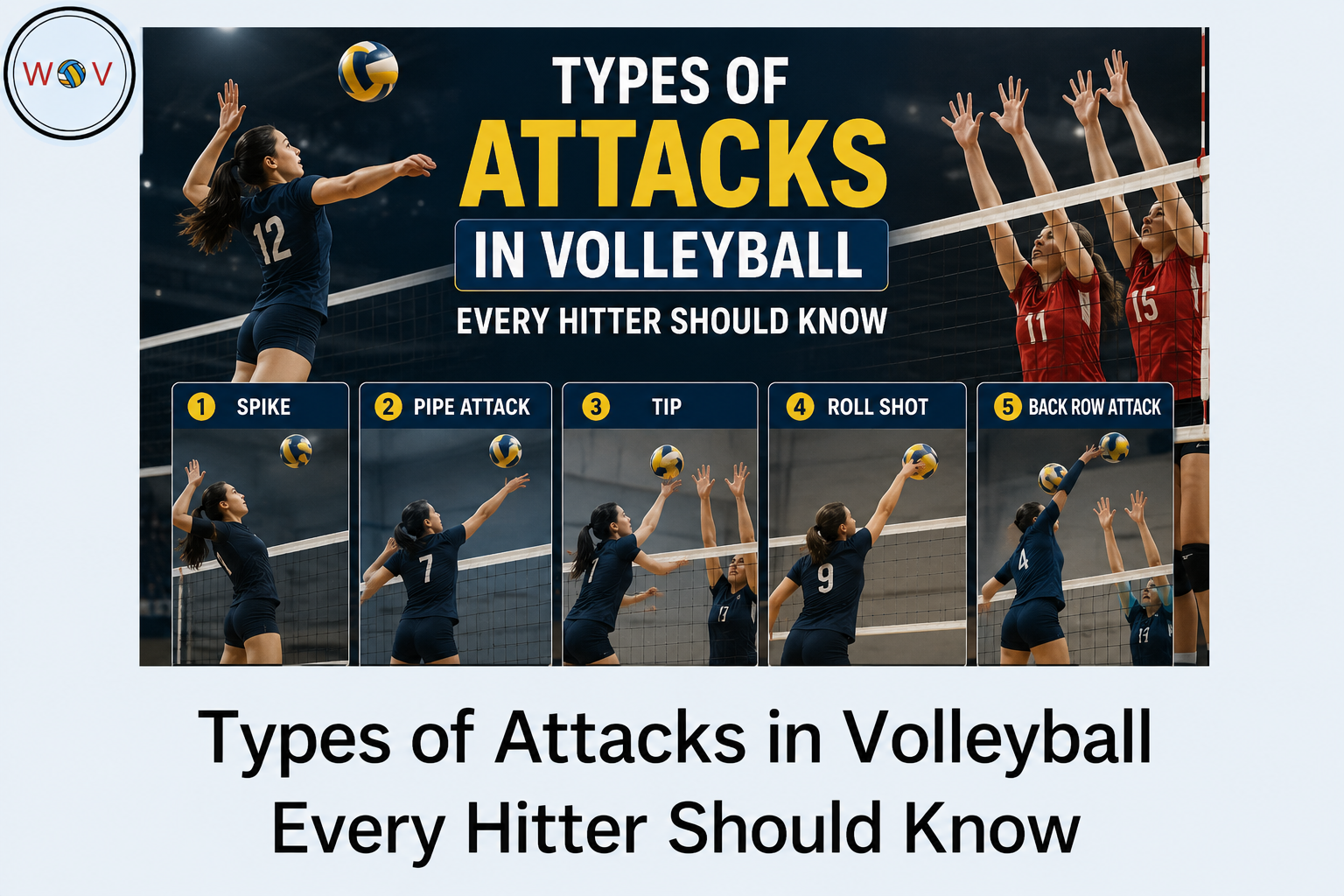
Types of Attacks in Volleyball Every Hitter Should Know
Winning is not a sometime thing, it is an all the time thing. You don’t do things right once in a while…you do them right all the time
Vince Lombardi
Source: Vince Lombardi.
Wonder of Volleyball is reader supported. Some of the links contained in this post are affiliate links. If you click and purchase through those links, we’ll get a commission at no additional cost to you. Read our full disclaimer here.
Thanks in advance for supporting our work!
What are the types of attacks in volleyball that every hitter must know?
Do you want to clearly understand each attack type in detail?
Then you are in the right place, keep reading till the end!
Attack in volleyball is one of the critical offensive skills and in this guide, we’ll take a thorough look at the types of attacks in volleyball and how to get good at each one.
Let’s get started. Shall we?
Did you know that quick attacks are designed to give blockers and defenders less than a second to react? Changing the speed of an attack can be just as effective as changing its direction.
Types of Attacks in Volleyball
What Does an Attack Mean in Volleyball? Understanding the Basics
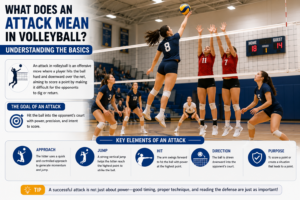
In volleyball, an attack refers to any offensive play where a player sends the ball over the net with the intention of making it difficult for the opposing team to defend and score a point for their team. While many beginners immediately associate attacks with powerful spikes, attacks can actually include a variety of hitting variations such as tips, rolls, quick hits and controlled shots placed into open areas of the court.
- The main purpose of an attack is to create scoring opportunities by forcing the opponent into uncomfortable defensive positions or by hitting the ball where defenders are less likely to make a successful pass.
- A well-executed attack is not always about power alone. Timing, shot selection, ball placement and reading the opposing blockers and defenders are equally important.
- Attacks usually happen on the third contact of a team’s offensive sequence after a pass and set, although quick attacks may happen faster depending on the team’s strategy and tempo of the match. Hitters often work closely with setters to decide the best attacking option based on the quality of the pass, blocker positioning and the flow of the rally.
For beginner players, understanding attacks is an important step in learning how offense works in volleyball. Developing a variety of attacking skills allows players to become more unpredictable, effective and valuable contributors to their team’s offensive.
The Power Spike: A Fundamental Attack
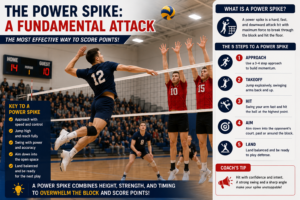
It is one of the most recognizable and effective attacks in volleyball.
- The power spike involves a hitter jumping near the net and striking the ball with force and downward direction, making it difficult for defenders to react and control the ball. This attacking method is commonly used to finish rallies and score direct points for the team.
- A successful power spike starts with a proper approach. Most hitters use a three-step or four-step approach to build momentum before jumping.
- Timing is equally important, as players must coordinate their jump with the setter’s delivery to contact the ball at the highest possible point. Reaching high above the net gives hitters a better angle to direct the ball sharply downward into the opponent’s court.
- Arm swing mechanics also play a major role in generating power. A strong backswing, quick arm acceleration and full follow-through help maximize force while maintaining control over the ball.
- However, power alone is not enough. Hitters must also focus on placement by targeting open spaces, hitting around blockers and using angles that make defensive coverage more difficult.
Mastering the power spike takes patience and repetition for beginner players. Developing jumping ability, footwork, arm coordination and timing with the setter are all essential parts of improving this skill.
Even if a player cannot hit with maximum force right away, learning proper technique early creates a strong foundation for more powerful and efficient attacks in the future. Because of its ability to apply pressure and score quickly, the power spike remains a core offensive weapon for hitters at every level of volleyball.
Smart Off-Speed Attacks to Outsmart Defenders
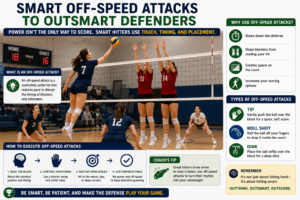
Not every successful attack in volleyball needs to be a powerful spike. Off-speed attacks are controlled offensive shots designed to catch defenders off guard by changing the pace, trajectory and placement of the ball.
These attacks are especially useful when blockers are well-positioned or when a full power spike isn’t the best option.
- Common off-speed attacks include tips, roll shots and soft placements into open areas of the court.
- A tip is a gentle redirection of the ball over or around blockers, often targeting spaces just behind the block where defenders may not be ready.
- Roll shots involve a more controlled arm swing with added topspin, allowing hitters to send the ball deep into uncovered zones of the court while maintaining better accuracy than a fully powerful spike.
- The effectiveness of off-speed attacks comes from deception and decision-making. Defenders often prepare for hard-driven attacks, which can leave them vulnerable to slower shots placed strategically into empty spaces.
- By mixing power attacks with softer shots, hitters become less predictable and force defenders to stay alert for multiple possibilities.
Good court awareness is essential when using off-speed attacks. Hitters should quickly scan the opposing defense before attacking to identify gaps, shifting defenders and weak coverage areas.
Choosing the right moment to use an off-speed attack can turn a difficult offensive situation into a smart scoring opportunity.
The Back Row Attack and Why It Adds More Offensive Options
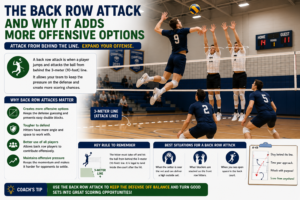
- A back row attack is an offensive play where a player attacks the ball while taking off from behind the attack line, also known as the three-meter line or ten-foot line. This allows back row players to become active scoring threats without violating front row attacking rules.
- Back row attacks are commonly used by opposites, outside hitters rotating into the back court or specialized back row attackers depending on the team’s offensive making. Since these players approach from deeper positions on the court, they can generate strong momentum and attack the ball with power while creating different angles that may be harder for blockers and defenders to anticipate.
- One major advantage of the back row attack is that it increases the number of available attackers during a rally. Instead of relying only on front row hitters, teams can involve additional offensive options, making it more difficult for opponents to predict where the next attack will come from. This added variety can spread blockers across the net and create more one-on-one opportunities for hitters.
- Successful back row attacks require strong timing between the setter and attacker. Because the hitter is approaching from farther away, the set must be delivered accurately to match the hitter’s speed, approach and jump timing.
Understanding the back row attack helps beginner players know that offense in volleyball is not limited to players standing at the net. It highlights how teams can use positioning, timing and multiple attack variations to create a faster, less predictable and more dynamic offense during matches.
Must’ve Gear for Volleyball Players
Quick Attacks in Volleyball: Speeding Up the Offense at the Net
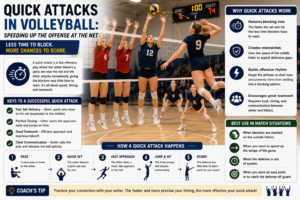
Quick attacks are fast-paced offensive plays designed to reduce the amount of time blockers have to react at the net. Instead of waiting for a high set, the hitter approaches and jumps almost simultaneously with the setter’s delivery, meeting the ball at a much faster tempo.
This creates a quicker offensive rhythm and can make blocking far more challenging for the opposing team.
- Quick attacks are most commonly used by middle hitters, as they are positioned close to the setter and can transition rapidly into an attacking approach. Popular quick attack variations include the first-tempo quick set, where the hitter jumps before or as the setter contacts the ball, and slightly delayed quick variations that still prioritize speed while allowing more flexibility in timing.
- The biggest advantage of quick attacks is that they force blockers to make decisions under pressure. Because the ball is attacked so quickly, opposing blockers often have less time to close the block or properly position themselves. This can create open hitting lanes, one-on-one matchups or confusion within the opponent’s defensive play.
- Executing quick attacks successfully requires excellent chemistry between the setter and hitter. Timing, communication and repetition are all essential, since even small mistakes in spacing or tempo will disrupt the play.
Quick attacks demonstrate how speed can be just as valuable as power in volleyball offense. While these plays may take time to master, learning the concepts of quick attacks help players understand offensive tempo and how teams can create scoring opportunities by attacking before the defense is fully prepared.
Slide Attacks and Other Advanced Hitting Options
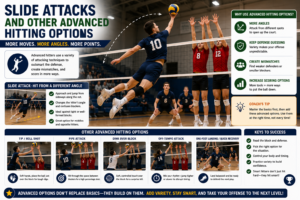
As players become more comfortable with basic attacks, they can begin exploring advanced hitting variations that add more variety and unpredictability to an offense.
One of the most well-known advanced attacks is the slide attack, commonly used by middle hitters.
- A slide attack involves the hitter taking an angled or lateral approach behind the setter before jumping off one foot to attack the ball. Instead of moving straight toward the net, the hitter travels across the court, allowing the setter to deliver a fast set into the attacker’s path. This movement can make it more difficult for blockers to track and close the block effectively.
- One major advantage of the slide attack is that it creates different attacking angles while spreading the offense across a wider area of the net. Because the hitter is moving laterally, blockers often have to adjust quickly, which can lead to mismatches or delayed blocking.
- In addition to slide attacks, advanced hitters may also use combination plays, sharper cross-court angles, line shots and tool shots that intentionally contact the blocker’s hands to send the ball out of bounds. These options require greater body control, court awareness and decision-making under pressure.
- Advanced hitting is not just about adding complexity for the sake of variety. It is about giving the offense more ways to create favorable attacking situations and making the hitter less predictable to defenders.
Knowing about these advanced attacks provide insight into how offensive skills can evolve over time. While mastering these attacks may come later, learning their purpose helps players appreciate the tactical depth of volleyball offense.
How to Choose the Right Type of Attack During a Match Situation
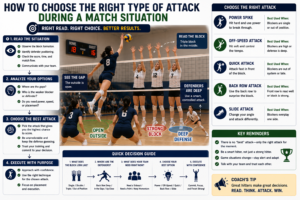
Choosing the right type of attack depends on reading the match situation and making quick decisions based on the current rally position.
- Effective hitters do not rely on the same attack every time. Instead, they adjust their choices according to the quality of the set, blocker positioning, defensive coverage and available attacking space.
- One important factor is the quality of the pass and set. A perfect set near the net will create an ideal opportunity for a power spike or quick attack, while an off-target or lower set may require a safer option such as a roll shot, tip or controlled off-speed attack.
- Hitters should also pay attention to the opposing blockers. If blockers are late or poorly positioned, a hard-driven spike may be the best option. If the block is well-formed and taking away major hitting angles, softer shots into open areas or attacks around the block can be more effective.
- Court awareness is equally important. Before attacking, hitters should quickly identify defensive gaps, deeper uncovered zones or areas where defenders have shifted out of position. Smart placement often wins points just as effectively as power.
- The stage of the rally can also influence decision-making. In high-pressure moments or difficult out-of-position plays, choosing a lower-risk attack may be more valuable than forcing an aggressive hit into a strong block.
Learning how to choose the right attack is an important step toward becoming a smarter and more complete hitter. Good attacking decisions combined with technical skills, awareness and adaptability will create more consistent scoring opportunities during matches.
FAQs on Types of Attacks in Volleyball
What is the Easiest Type of Attack for Beginner Volleyball Players to Learn First?
The easiest attack for beginners to learn is usually the basic power spike. It helps players develop proper footwork, jumping mechanics, arm swing technique and timing. Once these fundamentals improve, players can gradually add off-speed shots, tips and more advanced attack variations.
Are Powerful Attacks Always Better than Off-Speed Attacks in Volleyball?
No, powerful attacks are not always the best option. While hard-driven spikes can be effective, off-speed attacks such as tips and roll shots are useful for targeting open spaces and disrupting defensive rhythm. Smart hitters know when to mix both options.
Why is Attack Variety Important for Volleyball Hitters?
Attack variety makes hitters less predictable and harder to defend. Using different attacking variations forces blockers and defenders to adjust constantly, creating more scoring opportunities.
A well-rounded hitter can adapt to different match situations instead of relying on only one offensive style.
Conclusion
If you are playing the role of an attacker in your team, then knowing about the various types of attacks in volleyball is essential. Along with that knowledge, knowing when to use a particular type of attack will definitely help you be a valuable contributor to your team throughout the playing journey.
I am sure that by now, you’ll have a clear idea on the types of attacks in volleyball and how to get good at each one.
It’s your turn.
What are your thoughts about this guide?
Would you like to add any tip that helped you master the various types of attacks performed in volleyball?
Kindly share them away in the comments section below!
Related Posts
Blocking in Volleyball: Here’s Everything You Need to Know!
The Only Guide You Need to Know About Spiking in Volleyball
A Beginner Friendly Guide to Hitting in Volleyball
LET’S BE SOCIAL!

Great post! I really enjoyed how you broke down the different types of attacks and explained not only how they work but when to use them. So many players focus only on power, but your sections on off-speed attacks and court awareness highlight how important strategy and decision-making are in the game.
Hi Lisa, thank you very much. So glad to know that you found the tips in this post on attacks extremely clear and helpful for volleyball players.
Wow . I didn’t have a clue about any of this! Such a novice I am 🙂
Hi Kira, so glad to know that you learned something new about volleyball from this post!
I have very limited knowledge about volleyball and honestly thought spikes were all about power. This is definitely good to know, and I’m actually surprised that not all spikes need to be powerful. But it totally makes sense since changing the pace can really catch the opposing team off guard.
Hi Clarice, so glad to know that you learned something new about volleyball from this post.
I never knew that there was so much involved in attacks. There is so much more to the game than I realised.
Hi Jenny, glad to know that you’ve learned something new about volleyball from this post.
This is great. post! I would love a visual infographic to match this topic.
Hi JRC, thank you very much for the suggestion!
This was interesting. I know very little of volleyball. Didn’t know there were differences. Thanks for sharing this.
Hi Mary Ann, glad to know that you learned something new about volleyball from this post.
An interesting article, very well explained for someone like me who knows little about volleyball. I really like the images with the information summarizing each section.
Hi Liliane, thank you so much. Glad to know that you’ve learned something new about volleyball from this post.
Thanks for the post! I am new to volleyball and it is great opportunity to learn about this game.
Hi Nika, thank you so much!
This is amazing to know. I am loving this game more and more every time I get to know it better. Such a beautiful game. The attacks are amazing and so much fun.
Hi Karen, very glad to know that!
This was really interesting to read because I never realized there were so many different types of attacks in volleyball. Most people probably only think about spikes, but I like how this breaks everything down in a way that is easy to understand. The part about changing speed being just as important as direction was especially interesting. Very informative for both beginners and people trying to improve their game.
Hi Ann, thank you so much. Glad to know that you found this post helpful for beginner players and players looking to improve their overall game.
I didn’t really know about attacking in volleyball at all! Thank you for sharing this information.
Hi Jupiter Hadley, glad to know that you learned something new about volleyball from this post.
I’m pretty sure I’ve seen a power spike before and it always amazes me how someone can have that much power in their arm. Thanks for the info on attackers x
Hi Rhian Scammell, so glad to hear that you’ve seen the power spike before and with consistent practice, getting a powerful striking arm is possible.
It was interesting to read your breakdown of volleyball attacks as I know little about them. It is important to be aware of the balance between power, timing, and also smart placement. Super helpful for players wanting to become more versatile and unpredictable.
Hi Melanie E, thank you very much and so glad to hear that you found this post helpful for volleyball players.
Anyone who is new to the sport of volleyball can learn so much from your website. It was great to learn more about the attack skills, thank you!
Hi Yeah Lifestyle, thank you so much for your kind words! Glad to know that you found the posts in this blog helpful for volleyball players.
I agree. Although I never played volleyball, I have played football and basketball. Once you know all the methods and become good at strategies, then winning is definitely easy. 🏆💪
Hi Moni Lodha, thank you very much. So happy to know that you found this post relatable and you played football and basketball.
I learn so much reading your posts. I didn’t even know there were types of attacks. I thought they just hit it any way they could.
Hi Beth, very happy to know that you found this post helpful to learn something new about volleyball.