
A Beginner Friendly Guide to Hitting in Volleyball

There is pressure on every play. You can’t make a mistake, but that also means your opponent can’t make a mistake. It makes the matches more exciting to watch.
Holly McPeak
Source: Sports Feel Good Stories.
Wonder of Volleyball is reader supported. Some of the links contained in this post are affiliate links. If you click and purchase through those links, we’ll get a commission at no additional cost to you. Read our full disclaimer here.
Thanks in advance for supporting our work!
Do you want to understand the nuances and the importance of hitting in volleyball as a player?
What are the steps involved in mastering this critical skill?
Read along to find out!
Hitting plays a major role in volleyball. You may have heard this statement several times. Right?
But you may not have a clear idea on how to become a reliable hitter in your team.
So in this post, you’ll get to know everything about hitting in volleyball and the steps to take for mastering this valuable skill as a player.
Let’s get started!
Did you know that the fastest spike ever recorded in professional volleyball was by Bulgarian player Matey Kaziyski, who hit the ball at a blazing speed of 132 km/h (82 mph!)
Pin this post to your favorite board!
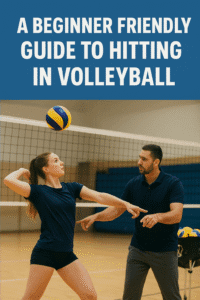
Here’s What You Need to Know About Hitting in Volleyball
What Does Hitting Mean in Volleyball?
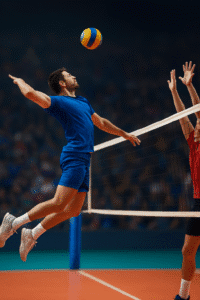
Hitting In volleyball is the action of accurately and forcefully striking the ball over the net into the opponent’s court, usually in an attempt to score a point. It is also commonly known as a ‘spike,’ especially when done with power and speed.
Hitting is one of the most exciting and aggressive plays of the sport and is typically performed by front-row players. Although this is the case, back-row attacks are also allowed.
A successful hit combines timing, accuracy, technique and power. The goal is to send the ball to a spot on the opponent’s side where it’s difficult to return, either by aiming at gaps in their defense or overpowering blockers with a powerful smash.
Hitting involves more than just swinging your arm. It starts with an approach (a sequence of steps,) followed by a jump, then a coordinated arm swing to make contact at the highest point possible. Good hitters also keep an eye on the opposing blockers and defenders to make smart decisions about where to place the ball.
For beginners, understanding the mechanics of hitting is critical and they must keep in mind that it isn’t all about strength. This skill is a combination of coordination, control and confidence.
Even if you can’t jump high or hit hard in the initial stages, understanding the basics of hitting will help you become a more valuable player on the court.
The Key Components of a Successful Volleyball Hit
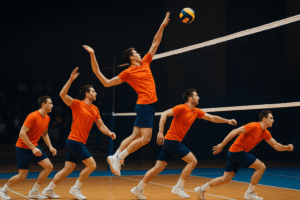
A successful volleyball hit is the result of several key components working together smoothly. It’s not just about power alone.
This skill requires timing, accuracy, technique and body control.
- This is the movement leading up to the jump. A good approach involves a quick and controlled sequence of steps (usually three or four) that helps build momentum and body positioning for an effective hit.
- It is crucial. The higher you can jum[p, the better your angle over the net to hit the ball and produce the intended result. A strong vertical jump gives you the advantage to hit above blockers with power/finesse depending on the situation of the match and place the ball with more precision.
- Arm Swing. The arm should swing in a fluid, whip-like motion. A good swing includes full shoulder rotation, elbow positioning and a strong wrist snap at the point of contact for getting speed and power to your hits.
- Jumping too early or too late can throw off the hit completely. Timing your jump is essential to make clean contact with the ball.
- Ball Contact. The ball should be struck with the palm of your hand, using a firm, open hand for better control and direction.
- Follow-Through. A complete follow-through adds power and accuracy. Your hitting arm should continue downward after contact, guiding the ball to the intended target.
When these components align, a hit becomes not only powerful but also smart and effective.
Understanding the Hitter’s Approach and Footwork
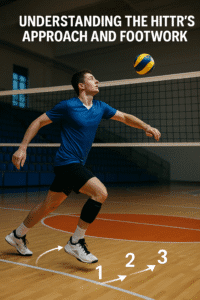
The hitter’s approach in volleyball is a sequence of steps used to build momentum, get in position and generate power for the jump and hit. For beginners, mastering this movement is essential to becoming an effective attacker.
- The most common approach is the three-step approach for right-handed players and if you exactly reverse it, this becomes the approach for the left handed players.
- Left-Right-Left (reverse for left-handed players. Right-Left-Right.)
- The steps begin slow and controlled, then get faster and more explosive.
- The last two steps are the most powerful. They help convert forward motion into vertical lift.
Footwork is all about balance and rhythm. The goal is to stay controlled while generating enough speed to jump high and make a powerful contact when hitting the ball.
Good footwork also helps with body alignment. It helps you face the ball and the net correctly. This in fact allows for a more powerful and accurate hit.
Here are some key points to remember.
- Start behind the attack line to give yourself space to accelerate.
- Stay low during the first step to build energy.
- Take your last two steps quickly to drive your jump upward.
- Use your arms to assist with lift and balance during the jump.
Practicing this footwork repeatedly helps build muscle memory. Even at the beginner level, a consistent and well-timed approach can make a huge difference in how effective and confident you feel while hitting.
Arm Swing Techniques: How to Hit the Ball with Power and Control
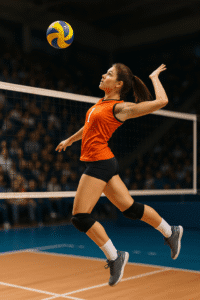
A strong and controlled arm swing is essential for delivering a powerful and accurate hit. For beginners, developing the right technique starts with understanding each part of the swing.
- Starting position. As you jump, bring your hitting arm back with a bent elbow and open hand, while your non-hitting arm points toward the ball. This helps with balance and alignment.
- The swing path. Think of your arm as a whip. The motion begins from the shoulder, followed by the elbow, then the wrist. The elbow should lead as the arm comes forward, creating a fast and fluid motion.
- Contact point. Aim to contact the ball at the highest point of your jump with a firm, open palm. Hit through the middle of the ball to generate power and keep it in control.
- Wrist snap. Just before and at contact, snap your wrist downward. This adds more power, which helps the ball drop faster into the court and stay in bounds.
- Follow-through. After contact, your arm should naturally continue downward across your body. This keeps the hit smooth and adds directional control.
Beginners often try to muscle the ball, but a proper swing uses technique over strength. Practicing correct arm swing builds consistency and reduces the risk of injury.
Over time, this technique will give you both the power to score and the control to place the ball smartly and accurately.
Must’ve Gear for Volleyball Players
Common Types of Volleyball Hits Beginners Should Know
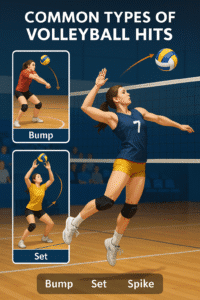
Hitting in volleyball isn’t just about one powerful move. There are several types of hits players will use, each serving a different purpose based on the situation.
As a beginner, understanding these types helps you become a more versatile attacker in your team.
- The most common and aggressive hit. A spike is a hard-driven ball aimed at scoring a point by overpowering the opponent’s defense.
- Instead of swinging hard, the hitter gently places the ball over the net with their fingertips. This is useful when blockers are ready for a spike, or when you spot an open area on the court.
- Roll shot. A mix between a spike and a tip. The hitter swings gently with a full motion, adding spin to the ball to make it drop quickly into their opponent’s court.
- Back row attack. This is when a back-row player jumps from behind the attack line to hit the ball. It’s strategic and often catches defenses off guard.
- Tooling the block. This technique involves purposely hitting the ball off the opponent’s block so it deflects out of bounds—earning your team the point.
Each hit serves a different purpose. Learning when and how to use them gives beginners more confidence and control during matches.
Hitting Tips for Beginners to Improve Accuracy and Timing
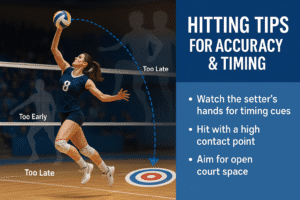
When it comes to hitting in volleyball, accuracy and timing often matters more than pure power. Developing these two areas can make you a more reliable and effective hitter on the court.
- Watch the ball. Keep your eyes on the ball from the moment it leaves the setter’s hands. Tracking it closely helps you time your jump and swing with better precision.
- Wait for the set to complete. Beginners often jump too early for a hit. Be patient. Start your approach once the ball reaches its peak in the set. This helps you hit at the right height and add sufficient amount of power.
- Use proper footwork. A consistent approach improves your rhythm and helps you get into position for a more accurate hit.
- Focus on contact point. Always aim to hit the ball at the highest point of your jump with a firm, open hand. This improves control and allows for better ball placement.
- Don’t over-swing. Trying to hit too hard can throw off your form and accuracy. Start with controlled swings, and increase power gradually as your technique improves.
- Practice placement. Instead of always aiming for powerful hits, practice placing to specific zones like deep corners or empty spaces. This builds your court and hitting awareness.
Improving accuracy and timing takes consistent practice, but the results will show quickly. These small adjustments will lead to big improvements in your overall performance as a hitter.
Avoiding Common Mistakes When Learning to Hit in Volleyball
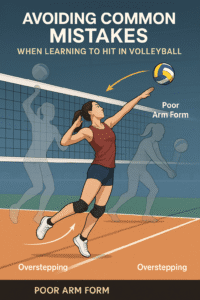
As a beginner, it’s easy to develop habits that might hold back your performance as a hitter. Being aware of common mistakes early on can help you correct them faster and build a stronger foundation.
- Jumping too early or too late. Poor timing throws off your entire hit. Always watch the ball and time your jump with its rise.
- Not having a proper footwork. Skipping steps or rushing your approach reduces power and control of the ball. Stick to a consistent three- or four-step approach to stay balanced and in rhythm.
- Swinging with a closed fist. Hitting the ball with a closed fist limits accuracy and can lead to unnecessary injuries. Always use an open hand for cleaner contact and better ball control.
- Not using the non-hitting arm. Failing to lift your non-hitting arm for balance affects your jump and swing direction. Using your non-hitting arm helps align your body and improves coordination during the hit.
- Focusing only on power. Trying to hit too hard without proper technique often leads to errors. Focus on form first. Power will come naturally with repetition and consistent practice.
- Ignoring court awareness. Beginners often hit the ball directly at defenders. Understand how to recognize open spaces and adjust your hit accordingly.
By avoiding these common mistakes and focusing on improving your hitter skills, you’ll see faster progress and gain more confidence in your hitting ability.
FAQs on Hitting in Volleyball
How Long Does it Take to Get Good at Hitting in Volleyball as a Beginner?
With regular practice, most beginners can learn the basics of hitting within a few weeks. Mastery takes time, but consistent drills and feedback help speed up the progress.
Do You Need to be Tall for Becoming a Good Hitter in Your Volleyball Team?
A big no. While height is surely an advantage, timing, technique, accuracy and smart ball placement matter more. Many successful hitters rely on their skill over their tallness/reach.
What’s the Best Drill to Improve Hitting Accuracy for Beginner Volleyball Players?
Target hitting drills like aiming for cones or specific zones on the court are great for building accuracy and ball control for beginner volleyball players.
Conclusion
If a team has a reliable hitter, then they have much higher chances of converting more opportunities to points. Also, they’ll be able to change the momentum of a match quickly.
I am sure that by now, you’ll clearly know the importance of hitting in volleyball and the steps you need to take to master this skill.
Now, it’s your turn!
What are your thoughts about hitting in volleyball?
Would you like to share any valuable tips?
Put them away in the comments section below!
Related Posts
Everything You Need to Know About How to Control the Direction of a Pass in Volleyball
How to Pass in Volleyball? Here’s What You Need to Know!
How to Properly Dive in Volleyball? A Detailed Guide
LET’S BE SOCIAL!

Great tips and information! Hitting is crucial and the help here will be valuable. Thanks!
Hi Janet, thank you very much and glad to know that you found this post helpful!
Great info! I appreciate the ideas for drills to help practice this skill. Thank you.
Hi Colleen, thanks for your comment. Glad to know that you found this post helpful.
Great Tips listed here – I feel like my beach Volleyball days are arriving sooner rather than later after reading this blog.
Hi JRC, thanks for your comment. Glad to know that you found the tips in this post helpful and you are going to start playing beach volleyball. All the very best!
Hitting is something that I have heard is a major part of volleyball, but I have never had these tips or it broken down so easily. Thank you for sharing!
Hi Jupiter Hadley, Thanks for your comment. Glad to know that you found this post helpful.
Thank you so much for breaking this down in such a simple way! As a mom with kids just starting volleyball, I really appreciate the clear steps and tips.
Hi LavandaMIchelle, thanks so much for your encouraging words. Very glad to know that your kids are starting in volleyball. Convey my best wishes to them!
Such a clear, beginner-friendly guide to hitting in volleyball! Loved the breakdown of timing, technique, and power. Feeling more confident to practice now.
Hi Jaishree, thanks a lot for your encouraging words. Glad to know that you found this post helpful. All the best!
Thank you for always sharing tips like this. My sister learned so much from your blog post. Looking forward to more.
Hi Marie Cris Angeles, thank you very much! Glad to know that your sister found this post helpful.
As a former volleyball player, this content is great! it is very helpful!
Hi Francesca, thank you very much for your kind words. Very happy to know that you found this post helpful and you are a former volleyball player.
Spiking definitely takes practice. Even just playing for fun, you have to play enough to get into the rhythm of things. Timing is everything otherwise I’m tripping over my feet.
Hi Laurel, thanks for your valuable comment. I totally agree with your points and surely, hitting in volleyball takes lot of practice.
I really had no idea so much went into hitting a ball. I never realized that even things like the steps were so important.
Hi Ben, glad to know that you’ve learned some unknown aspects about hitting in volleyball from this post.
Can’t play to save my life but this blog makes we want to try again
Hi Zanny, glad to know that you want to try playing volleyball again. All the best!
It sounds like there is a lot of skill involved in hitting. As with everything, practice makes perfect.
Hi Yeah Lifestyle, thanks for your comment. I totally agree!
I really value this information—hitting has always been one of the skills I wanted to understand better. This post makes it much clearer and more approachable.
Hi Ann, thank you very much for your encouraging words. Glad to know that you found this post helpful.
Wow! Didn’t know about Matey Kaziyski’s speed. That is very fast. Informative as always, I have lots more to learn. Thank you for sharing.
Hi Camille L, thank you very much for your appreciative words!
There is so much more to hitting the ball than you would first realise. Plus as they say practice makes perfect
Hi Samantha Donnelly, I 100% agree with your points!
When you watch the games, it seems so simple, but it’s not. I always thought you had to be tall to be a hitter… It’s always fun and interesting to learn more about this sport so thanks for sharing!
Hi Ginger, thanks for your comment. Glad to know that you found this post interesting to read.
I love the tip on emphasising placement over raw power. That’s a great way to have people diving for balls and keeping them off balance.
Hi Claudia, that’s an awesome strategy and I totally agree with you!
This is a great guide. I really had no idea so much went into hitting. I didn’t realize the steps leading up to the hit were so controlled!
Hi Beth, thank you so much for your kind words. Glad to know that you’ve learned something new about hitting in volleyball from this post.
After reading, I feel way more confident to try volleyball! Thank you for the beginner tips!
Hi Michelle, very happy to know that! All the best!
This is beyond interesting, thank you so much Hari…I am fascinated by how these players manage to jump that high and hit the ball with such power, just amazing….
Hi Karen, glad to know that you enjoyed reading this post!