
Basic Rules of Volleyball: A Complete Guide for Beginner Players
Superior athletes want to be accountable for their own results.
Marv Dunphy
Source: Volleyball Expert.
Wonder of Volleyball is reader supported. Some of the links contained in this post are affiliate links. If you click and purchase through those links, we’ll get a commission at no additional cost to you. Read our full disclaimer here.
Thanks in advance for supporting our work!
Are you just getting started as a beginner player and looking to understand the basic rules of volleyball?
Are you looking for comprehensive information that’ll enable you to start confidently as a beginner player?
Keep reading till the end to clearly understand everything!
Getting a firm grip on the basic rules of volleyball as a beginner player will be the ideal step in your playing journey.
In this post, we’ll take a closer look at the basic rules of volleyball and how to understand each one effectively as a beginner player.
Let’s get started!
Did you know that if a serve touches the net but still crosses into the opponent’s court, the ball remains completely legal and playable? This is often surprising to new players who assume any net contact automatically ends the rally.
Basic Volleyball Rules for Beginner Players
Understanding the Main Objective and Basic Structure of a Volleyball Match

I’ve already discussed in detail about the main objectives and the basic structure of a volleyball match, so here’s a small recap.
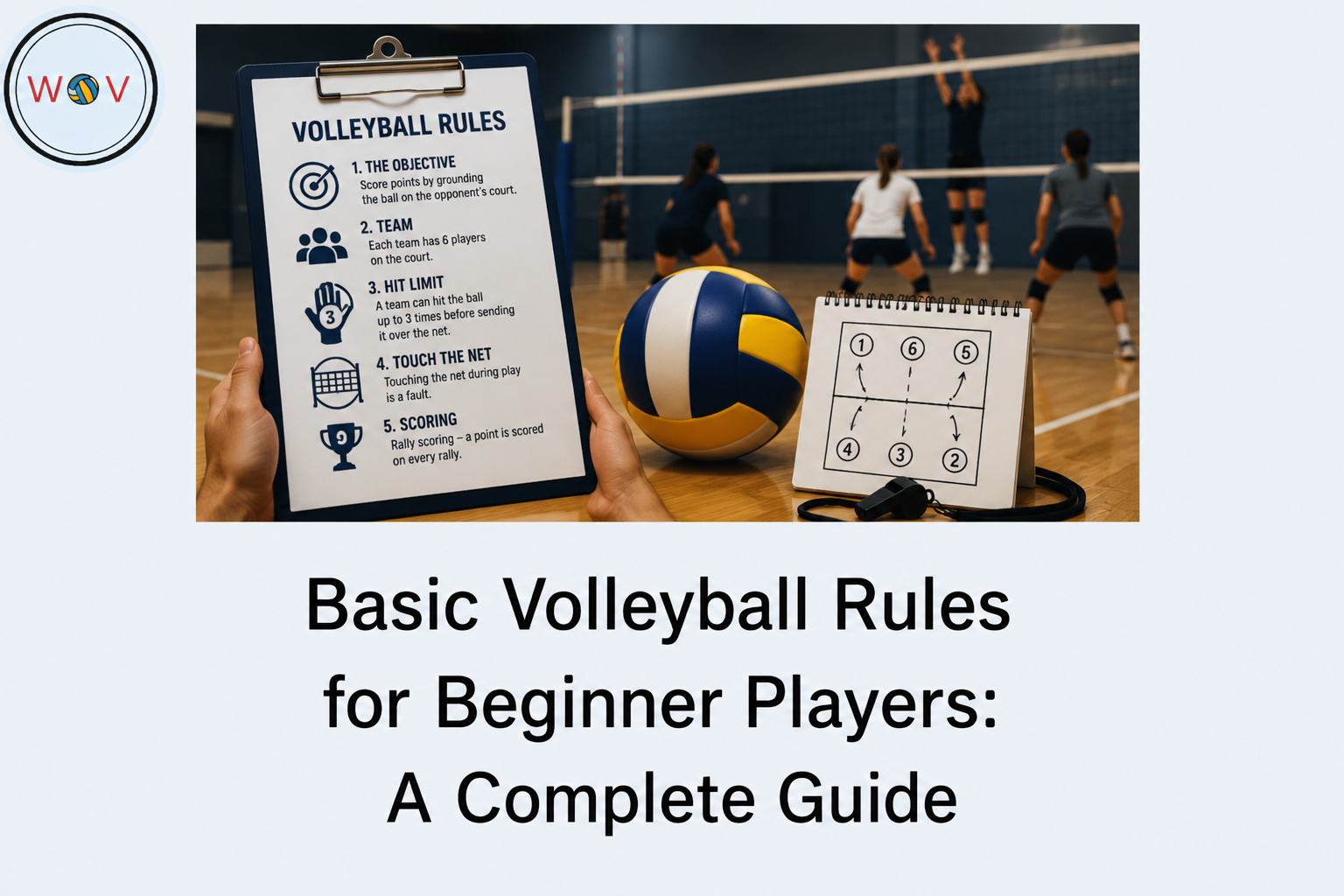
- The main objective of volleyball is simple: score points by sending the ball over the net and grounding it on the opponent’s side of the court while preventing the opposing team from doing the same on your side.
- A team can also win points when their opponents commit faults such as hitting the ball out of bounds, touching the net or making illegal contacts.
- A standard volleyball match is played between two teams, with six players on each side of the court. The game takes place on a rectangular court divided equally by a net.
- Each team works together to pass, set and attack the ball strategically in an attempt to score.
- Volleyball matches are usually played in a best-of-five sets format. This means a team must win three sets to win the match.
- The first four sets are typically played to 25 points, while the deciding fifth set, if needed, is played to 15 points. However, a team will be declared winners of a set only if a team leads by at least two points ahead of their opponents.
- During a rally, each team is allowed a maximum of three contacts to return the ball over the net, not including a block touch. Players must communicate effectively, stay in proper positions and follow rotation rules throughout the match to maintain fair play and team coordination.
Number of Players, Team Positions and Rotational Rules in Volleyball
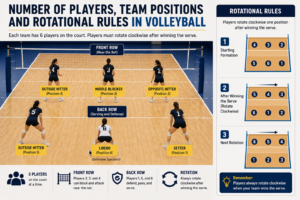
- In a standard volleyball match, each team has six players on the court at one time. These players are divided into two rows: three front-row players positioned near the net and three back-row players positioned closer to the baseline.
- Teams may also have substitute players available on the bench depending on the competition rules.
- Each player usually has a specific role on the team. Common positions include the setter, outside hitter, opposite hitter, middle blocker, libero and defensive specialist.
- The setter is often responsible for organizing the offense by delivering accurate sets to attackers. Hitters focus on scoring points through attacks, while middle blockers help defend against opponent attacks at the net.
- The libero is a specialized defensive player who mainly handles passing and digging in the back row.
- One of the most important rules beginners must understand is player rotation. Teams rotate clockwise whenever they win the right to serve after previously receiving serve from the opponent. This ensures all players move through both front-row and back-row positions during the match.
- The six court positions are numbered from 1 to 6. Position 1 is the back-right serving area, followed by positions rotating clockwise around the court. Players must begin each rally in their correct rotational order. Although players can move after the serve is contacted, overlapping or standing out of rotation before the serve can result in a positional fault and loss of point.
Understanding rotations is essential because it keeps gameplay organized, ensures fairness and helps players learn their roles and responsibilities in different areas of the court.
How Scoring Works: Sets, Points and Winning the Match
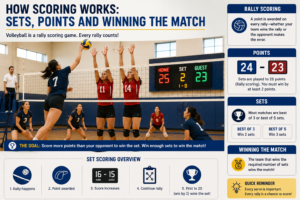
- Volleyball uses a rally scoring system, which means a point is awarded after every rally regardless of which team served the ball. A team can score by successfully grounding the ball on the opponent’s side of the court or when the opposing team commits a fault, such as hitting the ball out of bounds, touching the net or making an illegal contact.
- Most indoor volleyball matches follow a best-of-five sets format. The first team to win three sets wins the overall match. This format is commonly used in school, club, collegiate and professional volleyball competitions.
- The first four sets are typically played to 25 points. However, simply reaching 25 points does not automatically end the set. A team must win by at least two points. For example, if the score reaches 24–24, the set continues until one team gains a two-point advantage, such as 26–24 or 27–25.
- If both teams win two sets each, the match moves into a deciding fifth set, often called the tiebreaker set. Unlike the first four sets, the fifth set is usually played to 15 points, but the two-point winning margin rule still applies.
- Teams switch sides of the court between sets, and in many competitions, teams also switch sides midway through the deciding set once one team reaches 8 points.
Knowing how scoring works is important for beginner players because it helps them stay mentally engaged throughout the match, manage pressure during close sets and recognize that every rally matters from the first point to the last.
Essential Serving Rules Every Beginner Player Should Know
This is undoubtedly one of the most important skills in volleyball.
- The serve is the action that starts every rally, making it one of the most important basic skills to master and understand the rules associated with it for beginner players. A player serving the ball must stand behind the end line and hit the ball over the net into the opponent’s court.
- When serving, the player is not allowed to step on or cross the end line before making contact with the ball. Doing so results in a foot fault, which gives the opposing team a point and the right to serve. However, after contacting the ball, the server can step into the court.
- The serve must travel cleanly over the net and land within the opponent’s court boundaries. If the ball lands outside the court lines, hits the antenna, or travels completely under the net, it is considered out of bounds or an illegal serve.
- Also, players have a limited amount of time to serve after the referee whistles for service. Delaying too long can result in a service violation.
- Servers should also pay attention to the rotation order. Only the player currently positioned in the serving spot, typically Position 1, is allowed to serve. Serving out of rotation can result in a fault and loss of point.
- A served ball may touch the net and still remain legal as long as it crosses over and lands within the opponent’s court.
For beginner players, understanding serving rules is essential because it helps avoid unnecessary errors, improves consistency from the service line, and ensures the match begins fairly and smoothly on every rally.
Basic Ball Handling Rules and Legal Player Contacts
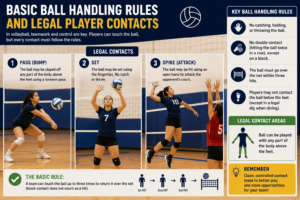
- In volleyball, each team is allowed a maximum of three contacts to return the ball over the net, not including a block touch. These contacts are commonly used as a pass, set and attack sequence to control the ball and create scoring opportunities.
- A player is generally not allowed to hit the ball twice in succession unless the first contact was part of a block. For example, if a player passes the ball and immediately touches it again before a teammate makes contact, it is considered a double contact fault.
- Players must also avoid catching, holding and throwing the ball. Volleyball is designed to involve clean and quick contacts, so prolonged contact with the ball is considered a lift or carry violation.
- Any part of the body can legally contact the ball in modern volleyball rules, including the feet and legs, as long as the contact is clean and the ball is not held or thrown.
- When receiving a serve or hard-driven attack, the first team contact is often judged more leniently, meaning the ball may contact different parts of the body during one motion as long as it is part of a single attempt to play the ball.
Ball handling rules are important because they help maintain fairness, encourage proper technique and keep rallies flowing smoothly. Beginner players who understand these rules can avoid common faults, make cleaner contacts and develop stronger control over the ball in every play.
Must’ve Gear for Volleyball Players
Common Faults and Violations That Result in Lost Points
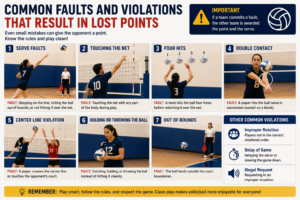
In volleyball, teams can lose points not only by allowing the ball to land on their side of the court but also by committing faults and rule violations during rallies. Understanding these common mistakes is important for beginner players because even small errors will quickly cost a team valuable points.
- One of the most common violations is hitting the ball out of bounds. This happens when a player sends the ball outside the court lines, into the antenna, or completely under the net.
- Another frequent mistake is making illegal contacts, such as double contact, lifting, catching or throwing the ball instead of making a clean hit.
- Net violations are also common. A player may be called for a fault if they touch the net during an active rally, especially while attacking, blocking or attempting to play the ball near the net.
- Position and rotation-based faults can also lead to lost points. If players are not in the correct serving order or overlap improperly before the serve, the referee will stop play and award a point to the opposing team.
- Serving violations are another common issue for beginners. Examples include stepping on or over the end line before serving, serving out of rotation and hitting a serve that lands outside the opponent’s court.
- Other faults include crossing the center line in a way that interferes with opponents, making more than three team contacts on the ball and attacking illegally from restricted positions.
Learning these common violations helps beginner players avoid preventable mistakes, play with better discipline and stay focused on executing skills correctly throughout the match.
Net Rules, Court Lines and Regulations in Volleyball
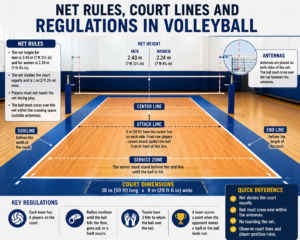
I’ve already talked about the volleyball court dimensions and the various lines involved in one of my previous blog posts, so if you want to get complete details, you can go ahead and take a look before continuing this one.
- The volleyball court is divided into two equal halves by a net, which separates the competing teams and creates the playing boundary between both sides. Beginner players should understand the importance of both the net and court lines, as many common violations are related to these areas.
- During a rally, players are generally not allowed to touch the net while attempting to play the ball. Contacting the net during various plays such as blocking, attacking and challenging a ball near the net usually results in a fault and a point for the opposing team.
- Players must also avoid interfering with opponents by reaching under or across the net in a way that disrupts play. However, reaching over the net may be legal in certain situations, such as following through on an attack or blocking an opponent’s attack without interfering illegally.
- The boundary lines define whether the ball is in or out of play. If any part of the ball touches a boundary line, it is considered in bounds. A ball landing completely outside the lines is ruled out.
- Another important marking is the attack line, often called the 3-meter or 10-foot line. This line separates front-row and back-row players. Back-row players must follow specific attacking rules when playing near or in front of this line.
Understanding court lines and net rules helps beginners improve court awareness, avoid unnecessary violations and make smarter decisions during rallies and net play.
Substitution Rules and Libero Basics for Beginner Players
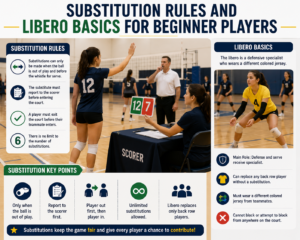
Substitutions in volleyball allow teams to replace one player with another during a match while following specific competition rules. Coaches often use substitutions to manage player fatigue, adjust team strategy and give different players opportunities to contribute.
- In most volleyball formats, substitutions can only happen during dead-ball situations, such as before a serve after the referee signals for a substitution. Teams usually have a limited number of substitutions allowed per set or match depending on the league or competition rules.
- When a regular substitution is made, players must follow substitution order rules. In many competitions, a starting player can leave the match and later re-enter, but usually only under certain conditions and often for the same player who replaced them.
- A unique position beginners should understand is the Libero. It is a specialized defensive player who wears a different colored jersey to be easily identified on the court. This player mainly focuses on passing, serve receive and defensive skills in the back row.
- The libero has special playing rules. In most cases, the libero cannot complete an attack hit above net height, block or attempt to block. The libero also replaces back-row players without counting as a regular substitution, which allows teams to maintain stronger back-row defense.
Understanding substitution rules and libero basics helps beginner players learn how teams manage rotations, maintain balance on the court and use specialized roles effectively during matches.
Timeouts, Match Delays and Other Game Interruptions
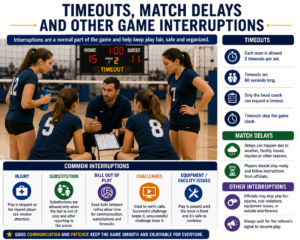
Volleyball matches include scheduled and unscheduled interruptions that temporarily stop play for strategic, administrative and safety reasons. Beginner players should understand these situations so they know what to expect during a match.
- A timeout is a short break requested by a team, usually by the coach or team captain, to discuss strategy, calm players or interrupt the opponent’s momentum. In most competitions, teams are allowed a limited number of timeouts per set, with each timeout lasting a specific amount of time according to league rules.
- Matches may also be paused for substitutions, injury evaluations, equipment issues or official reviews. For example, play may stop if a player is injured, the ball becomes damaged or there is an issue with the net, antenna or court conditions.
- Referees can also pause a match for administrative reasons, such as verifying player rotations, resolving scoring discrepancies or addressing rule violations. In higher-level competitions, video review systems may be used to confirm close calls.
- Delays caused by teams, such as intentionally slowing down the game or failing to return to the court on time, can sometimes result in warnings or penalties depending on the rules being used.
Knowing about the timeouts and match interruptions helps beginner players stay mentally prepared, remain focused during breaks and quickly reset when play resumes after unexpected delays or stoppages.
Referee Signals and How Officials Manage a Volleyball Match
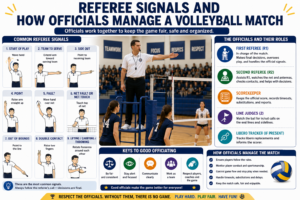
Volleyball officials play an important role in ensuring that matches are fair, organized and played according to the rules. Beginner players should understand how referees manage the game and use hand signals to communicate decisions clearly.
- A typical volleyball match is supervised by a first referee, a second referee, line judges and a scorekeeper depending on the level of competition. The first referee usually stands on an elevated platform near the net and has primary authority over the match. The second referee assists with substitutions, rotations, net violations and bench management.
- Referees use standardized hand signals to indicate decisions such as points awarded, faults, substitutions, timeouts and rotation violations. For example, a referee may raise an arm to signal which team will serve next or use specific gestures to indicate faults like double contact, net touch or out-of-bounds balls.
- Line judges help determine whether balls land inside or outside the boundary lines and may also signal touches off blockers or service faults related to the end line.
- Officials also monitor player conduct, enforce rules consistently and help resolve disputes that may arise during the match. Their decisions keep the match moving efficiently while maintaining fairness for both teams.
Learning common referee signals helps beginner players better understand match flow, react quickly to decisions and avoid confusion during rallies and stoppages.
Beginner-Friendly Tips to Avoid Common Mistakes Related to Volleyball Rules During Matches
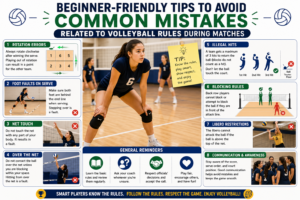
Learning volleyball rules is important, but applying them correctly during live matches is what truly helps beginner players improve and avoid unnecessary mistakes. Many rule violations happen simply because players lose focus or forget basic positioning and volleyball-related requirements.
- One helpful tip is to always stay aware of your rotation and court position before each serve. Many beginners accidentally overlap or stand in the wrong spot, leading to avoidable position-based faults.
- Players should also develop the habit of watching the referee before every serve. Waiting for the whistle and checking that your team is ready can help prevent serving too early, rushing or committing rotation errors.
- Practicing clean ball contact is another important habit. Avoid trying to catch, throw or over-control the ball, as these actions can result in lifts, carries or double contact violations.
- At the net, players should stay disciplined and avoid unnecessary contact with the net during blocking or attacking. Maintaining body control can reduce net faults and center-line violations.
- Communication is equally important. Calling for the ball clearly helps teammates avoid collisions, confusion and extra contacts caused by miscommunication.
- Finally, beginners should focus on staying calm after mistakes. Rule errors are a normal part of learning volleyball, and understanding them over time helps players become more confident, disciplined and match-aware during competition.
FAQs on Basic Volleyball Rules for Beginner Players
How Many Times can a Team Touch the Ball Before Sending it Over the Net?
A volleyball team is allowed a maximum of three contacts to return the ball over the net, not including a block touch. Teams commonly use these contacts as a pass, set and attack sequence to control the rally effectively.
Can a Volleyball Player Touch the Net During a Match?
No, players are generally not allowed to touch the net while actively playing the ball, blocking or attacking near the net. A net touch usually results in a fault and gives the opposing team a point.
Can a Volleyball Player Use their Feet to Play the Ball?
Yes, players are allowed to use any part of their body to contact the ball, including their feet and legs, as long as the contact is clean and the ball is not caught, thrown or held.
Conclusion
As I said earlier, mastering the basic rules of volleyball will be pretty useful till the time you play this wonderful team sport.
I am sure that by now, you’ll have a thorough idea on the basic rules of volleyball and how to effectively understand each one.
It’s your turn!
What are your thoughts about this guide?
What are the methods you used to understand the basic rules of volleyball?
Kindly share them in the comments section below!
Related Posts
An Introduction to Volleyball for Beginners
A Comprehensive Guide on the Do’s and Don’ts of Volleyball as a Beginner Player
7 Things You should Know as Volleyball Parents

I didn’t even know there were six players across two rows, that’s how much of a beginner I’d be. So this was super useful, thanks x
Hi Rhian Scammell, so glad to know that you’ve learned something new about volleyball from this post.
This is such a helpful post. I have always loved the idea of playing volleyball but never properly played it and had no idea of the basic rules!
Hi Rebecca Smith, so glad to know that you found this post helpful and learned something new about volleyball.
Thank you for such a detailed breakdown. I really have never understood the rules at all.
Hi Ben, thank you so much!
This is a very thorough explanation of the basic rules of volleyball. Thanks for sharing! This will be so helpful for those who want to learn more!
Hi Dusty, thank you very much. So glad to know that you found this post helpful for beginner volleyball players.
You always do such a good way of explaining volleyball, so that those of us who do not know much about it can really understand. Thank you for this breakdown of the rules.
Hi Jupiter Hadley, so glad to know that you found this post helpful.
There’s so much to know with volleyball. There’s so much that I had no idea about here. Such a handy guide. Everyone should read this before starting.
Hi Claire Chircop, thank you very much. So glad to know that you found this post helpful.
Volleyball looks like such a fun sport – full of energy. It is great to read more about the basic rules of the game.
Hi Yeah Lifestyle, totally agree with your first point and thank you very much.
This is so helpful. I love watching volleyball, but I’ve never been super clear on the rules. Thank you for this!
Hi Beth, so glad to hear that you love volleyball and found this post helpful.
So, so, so much to learn and consider with this! Will pass onto our PE department (I’m a secondary school teacher) – I’m sure our students will love this!
Hi kay, thank you so very much!
In most competitions, teams are allowed a limited number of timeouts per set, with each timeout lasting a specific amount of time according to league rules.
Hi Moni Lodha, thank you so much for reiterating these points that I’ve already talked in this post!
This is sooo cool, thank you so much Hari for the very valuable information. It is great to go back to basics, very helpful.
Hi Karen, so glad to hear that!
Thank you for explaining the basic rules of volleyball. I didn’t realise that there are five sets to play in volleyball, that makes it quite a long game then!
Hi Lucy, glad to know that you found this post helpful and learned a lot about the basic rules of volleyball.