
90 Volleyball Slang Words You Must Know as a Player

Getting the 25th point is our quest. Y’all think you can put our hitter to the test. But put that mind of yours to rest. Cuz you already know our spiker are the best.
A fun volleyball quote
Source: Dear Volleyball.
Wonder of Volleyball is reader supported. Some of the links contained in this post are affiliate links. If you click and purchase through those links, we’ll get a commission at no additional cost to you. Read our full disclaimer here.
Thanks in advance for supporting our work!
Do you have any idea on the volleyball slang words that are used during matches?
Do you want to know about the skill-based volleyball slang words that’ll be useful for you throughout your playing journey?
Then stick-around and read this guide till the end!
Every sport has slang terms that are familiar to its players. Knowing about them will make your job a lot easier in every possible way.
In this post, we’ll be taking a closer look at the 90 skill-based volleyball slang words, definitions for each one, what are volleyball slang words, how they are useful and much more.
So without any delay, let’s get started.
Did you know that most volleyball slang originated organically from players and coaches rather than official governing bodies? Over time, memorable plays, funny moments, and unique team cultures helped create a vocabulary that became part of volleyball’s identity.
Volleyball Slang Words for Players
What Are Volleyball Slang Words?
Volleyball slang words are informal terms and expressions commonly used by players, coaches and fans to describe specific actions, situations and plays during a match. These words often provide a quicker and more engaging way to communicate than using formal volleyball terminologies.
For example, players may use slang to describe a perfect pass, a powerful attack, a successful block or a difficult defensive play.
Learning volleyball slang can help players better understand conversations on and off the court, improve communication with teammates and become more familiar with the culture of the sport. Many of these terms are regularly heard during practices, matches and team discussions at different levels of play.
Whether you are a beginner player learning the sport or an experienced player looking to expand your volleyball vocabulary, understanding common volleyball slang words can help you follow matches more confidently and connect more effectively with other members of the team.
Passing
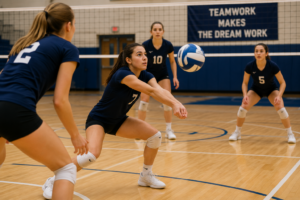
- A perfect pass that reaches the setter in an ideal position to run the offense.
- A badly executed pass that flies off target and makes the next play difficult.
- A pass delivered accurately and under control to the setter.
- A very smooth and effortless-looking pass.
- A slang reference to the forearm passing surface used to control the ball.
- Free Ball. An easy ball sent over the net that allows the receiving team to set up a pass and attack.
- Three-Pass. A high-quality pass that gives the setter every attacking option available.
- Seam Ball. A serve or attack directed between two passers, often causing confusion.
- Pancake Save. A defensive save where a player’s hand is placed flat on the floor beneath the ball.
- Pipe Pass. A pass that is accurate enough to help set up a back-row pipe attack.
- A pass that unintentionally travels over the net and becomes playable by the opponent.
- Target Pass. A pass directed precisely to the setter’s designated position on the court.
- Out-of-System Pass. A pass that forces the setter away from their normal setting position.
- A common slang term for a forearm pass used to receive a serve or attack.
- Serve Receive. The first pass made after an opponent’s serve to begin an offensive play.
Setting

- Dime Set. A perfectly placed set that gives the hitter an excellent opportunity to score.
- Butter Set. A smooth and easy-to-hit set delivered with great control.
- A slang term for setting the ball to a teammate for an attack.
- Toss Up. A set sent high into the air to give the hitter more time to approach.
- Quick Set. A fast, low set designed for a quick attack near the net.
- Shoot Set. A fast set delivered to an outside hitter along the net.
- Back Set. A set delivered behind the setter to an attacker on the right side.
- A surprise attack where the setter sends the ball over the net instead of setting it.
- Joust Ball. A ball played tight to the net that may require quick decision-making from the setter.
- One Ball. A very low and fast set hit immediately by the middle attacker.
- Two Ball. A slightly higher set than a one ball, usually directed to the middle hitter.
- Go Ball. A fast set sent high and wide to the outside hitter.
- Hut Set. A medium-height set to the outside hitter that balances speed and timing.
- Out-of-System Set. A set made from a difficult passing situation that limits attacking options.
- Setter’s Touch. A phrase used to describe a setter’s ability to consistently deliver accurate and hittable sets.
Blocking

- A dominant block that sends the ball straight back onto the attacker’s side of the court.
- Stuff Block. A block that immediately stops the attack and scores a point.
- Monster Block. An exceptionally powerful and emphatic block that shuts down the hitter.
- A slang term used when an attacker is completely blocked.
- Soft Block. A controlled block that slows the ball down, allowing teammates to dig it.
- Seal the Net. Closing the space between blockers to prevent the ball from passing through.
- Close the Seam. Moving alongside another blocker to eliminate gaps in the block.
- Extending the hands over the net to direct the blocked ball downward.
- Swing Block. A blocking technique where the blocker uses crossover footwork to move quickly along the net.
- Read Block. A block formed after watching the setter and hitter before jumping.
- Commit Block. A block where the middle blocker commits to one attacker before the set is delivered.
- Triple Block. Three front-row players working together to stop a powerful attack.
- Block Touch. A slight contact by the blocker that changes the ball’s direction before a dig.
- A hitter intentionally striking the block so the ball deflects out of bounds for a point.
- Pancake Roof. An informal phrase describing a spectacular block that drops almost straight to the floor on the opponent’s side.
Spiking
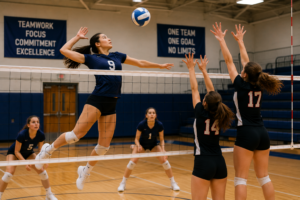
- An attack that lands on the opponent’s court for an immediate point.
- A powerful spike hit with tremendous force.
- A hard-driven spike that is difficult or impossible to defend.
- A spike that hits the floor and rebounds high into the air.
- An attack intentionally hit off the blocker’s hands and out of bounds for a point.
- Another term for intentionally using the blocker to deflect the ball out of bounds.
- A spike struck with exceptional speed and power.
- A slang term for swinging aggressively at the ball.
- A very fast and powerful spike that challenges the defense.
- A spike that travels in a straight, powerful line across the court.
- Cut Shot. A controlled spike angled sharply across the court to avoid blockers.
- Line Shot. A spike hit straight down the sideline.
- Cross-Court. A spike directed diagonally across the opponent’s court.
- A soft attacking touch placed over or around the blockers into an open area.
- Roll Shot. A controlled attack struck with topspin instead of full power to target open space.
Must’ve Gear for Volleyball Players
Digging

- A successful defensive pass that keeps a hard-driven attack from touching the floor.
- A last-second defensive save made by placing a flat hand underneath the ball.
- Pop-Up. A dig that sends the ball high into the air, giving teammates time to continue the rally.
- A fully extended dive used to reach a difficult attack.
- A quick, low defensive movement to dig a ball just before it hits the floor.
- A slight defensive contact that keeps the ball in play.
- A common call made after a successful dig to let teammates know the ball is still playable.
- A hectic defensive sequence where players work together to keep the ball alive.
- Any defensive play that prevents the ball from hitting the floor.
- Emergency Dig. A last-ditch defensive effort made when the attack is difficult to reach.
- Reflex Dig. A quick-reaction dig made against a fast or unexpected attack.
- Kick Save. A legal defensive play where a player uses their foot or leg to keep the ball in play.
- One-Arm Dig. A defensive save made using a single arm when two-handed contact isn’t possible.
- Slang for making a difficult dig by reaching or stretching to keep the ball alive.
- Floor Burn. An informal term describing the friction marks or scrapes players often get from aggressive diving and digging.
Serving

- A serve that lands untouched or cannot be returned legally, resulting in an immediate point.
- A powerful serve hit with exceptional speed and force.
- A slang term for an extremely hard and fast serve.
- A serve that travels quickly on a flat, direct trajectory.
- A serve with little or no spin that moves unpredictably through the air.
- Jump Float. A float serve performed with a jump to add speed while maintaining minimal spin.
- Jump Serve. A powerful topspin serve executed after a jumping approach.
- A slang term for a serve hit with explosive speed.
- Paint the Line. A serve that lands right on or extremely close to the boundary line.
- Short Serve. A serve intentionally placed just over the net to disrupt the opponent’s formation.
- Deep Serve. A serve targeted near the opponent’s end line to push passers backward.
- Zone Serve. A serve directed to a specific area of the court to exploit a weakness.
- Service Error. A serve that lands out of bounds or into the net, giving the opponent a point.
- Heat Check. A slang term for continuing to serve aggressively after multiple successful serves.
- Serving Run. A sequence in which one player scores several consecutive points while serving.
FAQs on Volleyball Slang Words for Players
Why Do Volleyball Players Use Slang Instead of Official Terms?
Volleyball slang makes communication faster and more natural during practices and matches. Many slang words are shorter, easier to remember and widely understood among players, helping teammates react quickly and build stronger on-court chemistry.
Are Volleyball Slang Words the Same at Every Level of Play?
Not always. Many slang terms are recognized across youth, high school, college and professional volleyball, but some vary by region, team culture or coaching style. Players may hear different expressions while describing the same skill/play.
How can Beginner Players Learn Volleyball Slang More Quickly?
The best way is to play regularly, watch volleyball matches, listen to coaches and teammates and practice using the terms during training. Over time, the meanings become familiar and help you communicate more confidently on the court.
Conclusion
Apart from communicating effectively with your fellow teammates and coaches, knowing about the volleyball slang words definitely gives you an edge during the crunch situations of a match. You don’t have to wonder what your teammate is saying and act according to the state of the play.
I am sure that by now, you have a clear idea on the volleyball slang words, what actually they are and how they will be useful throughout your playing journey.
It’s your turn!
How do you find these volleyball slang words?
Is there any particular term that sounds pretty unique to you?
Kindly share your thoughts in the comments section below!
Related Posts
15 Funny Volleyball Quotes Every Player Will Relate To
Famous Quotes by Volleyball Players to Inspire and Motivate Young Athletes
Noteworthy Advice from Successful Volleyball Parents for Beginner Volleyball Players
LET’S BE SOCIAL!

Very comprehensive list. I was familiar with a few but digging is new. Thank you for sharing.
Hi Andreia, so glad to know that you learned something new about volleyball from this post.
Maybe I will understand a bit more about what is going on when I watch the games now 🙂 Thanks for posting all these expressions in one place.
Hi Marissa, so glad to know that you learned something new about volleyball from this post.
That’s alot to learn. It must be hard to learn all this when you are just getting started This has been informative.
Hi Mary Ann, thanks a lot!
This list of volleyball slang words is very helpful. Knowing some of these slang words will be key in helping me understand what the players are talking about when I watch my granddaughter play.
Hi Karen Kasberg, thank you very much! So glad to know that your granddaughter plays volleyball. Convey my best wishes!
I never knew there were slang words being used. This is interesting. Learn something new everyday! Thanks for sharing!
Hi Dusty, so glad to know that you learned something new about volleyball from this post.
Great list! Even after watching volleyball for years, I learned a few new terms here. This is a really helpful guide for both new and experienced players.
Hi Lisa, thank you so much!
This is so fun! I definitely learned a few new terms today.
Hi Giangi Townsend, thank you so much!
That list of terms is actually pretty wild to go through. I honestly had no idea there were that many specific words to learn.
Hi Kat, so glad to know that you’ve learned something new about volleyball from this post.
Wow so many different slang words. It’s amazing how all different types of passes or blocks etc have their own naming conventions. It must be a lot to remember when you’re a newbie x
Hi Rhian Scammell, glad to know that you’ve learned something new about volleyball from this post.
I did not know there was so many slang words for Volleyball! Thank you for sharing the lingo.
Hi Jupiter Hadley, glad to know that you’ve learned something new about volleyball from this post.
There is definitely a lot to learn, including all the slang words. I guess this all comes over time and with experience to get to know all of the words.
Hi Yeah Lifestyle, you are correct!
Wow, 90! I thought the 10 or so terms a rugby forward needs to know when it comes to lineouts was a lot!
Hi Tracey Kifford, so happpy to know that you’ve learned something new about volleyball slang words from this post.
This is a fantastic guide for volleyball players! Learning the sport’s slang not only makes communication easier on the court but also helps players feel more connected to the game. Thanks for putting together such a helpful resource!
Hi Lisa, thank you very much! So glad to know that you’ve learned useful information about volleyball slang words from this post.
I didn’t know any of these! I always love learning something new here. This will help me understand yet another element of the game.
Hi Beth, so happy to hear that!
Some of this slang is amazing…Pancake save….so cool…I wonder if every volleyball player knows all these terms.
Hi Karen, thank you very much. Most players, especially in the competitive volleyball space, know most of these terms.