
Here’s Everything Players Need to Know About the Types of Hits in Volleyball

Good players rarely look like the game is stressful for them, and they never seem rushed because they adjust their position all the time based on what’s happening. They’re always compensating for the movement of their teammates and the movement on the other side of the court, whether it’s blocking or back court.
Doug Beal
Source: Flo Volleyball.
Wonder of Volleyball is reader supported. Some of the links contained in this post are affiliate links. If you click and purchase through those links, we’ll get a commission at no additional cost to you. Read our full disclaimer here.
Thanks in advance for supporting our work!
What are the different types of hits in volleyball that you must know as an attacking player of your team?
Would you like to know when to use each hit to maximize the chances of scoring for your team?
Then you are in the right place, keep reading till the end to know all the details!
Just like blocking, serving, setting and passing, hitting is one of the crucial skills that attacking players of a volleyball team need to get good at.
In this detailed guide, we’ll take a closer look at the different types of hits in volleyball, how and when to use each one to maximize the chances of scoring for your team and much more.
Let’s get started. €Shall we?
Did you know that a volleyball spike isn’t always intended to score a point? Sometimes hitters deliberately use an attack to force a weak pass, disrupt the opponent’s formation, or set up a better defensive position for their own team on the next play.
Types of Hits in Volleyball
What Does a Hit Mean in Volleyball?
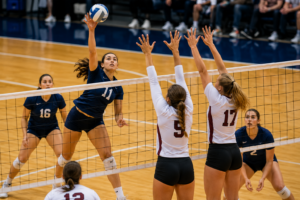
In volleyball, a hit refers to any intentional contact with the ball that directs it toward a specific area of the court, most commonly as part of an offensive play. While players make many types of ball contacts during a rally, such as passes, sets and blocks, the term hit is usually associated with attacks designed to challenge the opposing team’s defense and create scoring opportunities.
- Hits can be performed with power, precision or a combination of both. Some hits, such as spikes, rely on strength and speed to drive the ball to the floor.
- Others, including tips, dinks and roll shots, use placement and deception to exploit open spaces on the court. The type of hit a player chooses often depends on factors such as the quality of the set, the position of blockers and the defensive alignment of the opposing team.
- A successful hit requires more than simply making contact with the ball. Players must develop proper timing, footwork, body control and decision-making to execute different attacking variations effectively.
- Learning when and how to use various hits allows players to become more versatile and unpredictable on offense.
Understanding the different types of hits in volleyball is an important step toward improving your attacking skills and becoming a more complete player.
In the following sections, we’ll explore the most common hits used in a volleyball match and the situations where each one can be most effective.
The Spike: The Most Powerful Offensive Hit in Volleyball
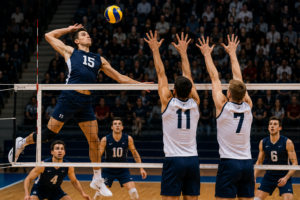
The spike is widely regarded as the most powerful and recognizable offensive hit in volleyball.
- It involves a player jumping and striking the ball forcefully with an open hand, directing it downward into the opponent’s court. The primary objective of a spike is to score a point by making the ball difficult or impossible for the opposing team to defend.
- A successful spike begins with a well-timed approach, followed by an explosive jump and strong arm swing. Players must coordinate their footwork, timing and body positioning to make solid contact with the ball at the highest possible point.
- The combination of power, speed and angle often makes spikes one of the most effective attacking variations in the sport.
- Spikes can be executed from various positions on the court, including the left side, right side and middle of the net. Depending on the situation, hitters may choose to attack cross-court, down the line or target specific gaps in the defense.
- More advanced players also learn to adjust the speed and placement of their spikes to avoid blockers and keep defenders guessing.
- While power is important, successful spiking is not just about hitting the ball as hard as possible. Good hitters understand how to read the opposing block, identify open areas of the court and make smart attacking decisions.
- Accuracy, timing and shot selection are often just as valuable as strength.
Because of its ability to generate points and put pressure on the opposing team, the spike remains one of the most important skills for offensive players to develop in volleyball.
Tips and Dinks: Using Finesse to Score Points
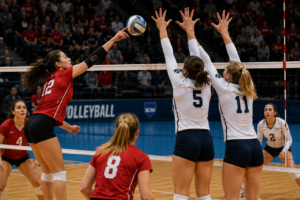
- While spikes rely on power and speed, tips and dinks are offensive hits that use finesse, touch and deception to score points. Instead of swinging aggressively, a player gently directs the ball over or around blockers and into an open area of the opponent’s court.
- These shots are especially effective when the defense is expecting a hard-driven attack.
- The terms tip and dink are often used interchangeably, though both describe soft attacking contacts intended to catch defenders out of position. A well-executed tip can drop just behind the block, while a dink may be placed into uncovered spaces that are difficult for defenders to reach in time.
- Tips and dinks are commonly used when blockers are positioned to stop a powerful spike or when the hitter recognizes a gap in the opposing defense. Because these shots travel more slowly than spikes, they rely heavily on timing, court awareness and ball placement rather than strength.
- Successful players learn to disguise their intentions, making the shot appear like a full attack until the last possible moment.
- Although tips and dinks may seem simple, they require excellent control and decision-making. Poorly placed soft shots can give the opposing team an easy opportunity to continue the rally or launch a counterattack. For this reason, players must carefully assess the court before choosing this option.
When used at the right moment, tips and dinks can be highly effective offensive weapons. They add variety to a player’s attacking game, keep blockers and defenders guessing and create scoring opportunities that pure power alone may not achieve.
Roll Shots and Off-Speed Hits: Combining Control and Accuracy
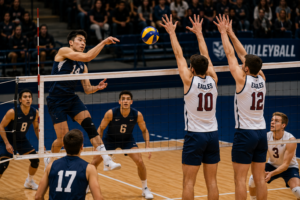
Roll shots and off-speed hits are attacking variations that prioritize control, placement and deception over raw power. These shots are often used when a hard spike is not the best choice or when a hitter wants to exploit weaknesses in the opposing team’s defensive positions.
- A roll shot is executed by using a controlled arm swing that sends the ball over the net with topspin and a higher arc than a traditional spike. Rather than driving the ball sharply downward, the hitter aims for open areas of the court where defenders are unlikely to be positioned.
- This makes roll shots particularly effective against well-formed blocks and deeply positioned defenses.
- Off-speed hits follow a similar concept but can include a variety of attacks delivered with reduced force. By changing the speed of the ball, hitters can disrupt the timing of blockers and defenders who are anticipating a powerful spike.
- These shots often catch opponents off guard because they require defenders to react differently than they would to a hard-driven attack.
- Successful use of roll shots and off-speed hits depends on court awareness, decision-making and precise ball control. Hitters must recognize defensive gaps, read the opposing block and choose the right moment to vary their attack.
- Using the same type of hit repeatedly can make an offense predictable, while mixing in softer attacks keeps opponents guessing.
Although these shots may not generate the same excitement as a powerful spike, they are valuable tools in a complete offensive strategy. Players who can effectively combine power attacks with roll shots and off-speed hits become more versatile attackers and create additional scoring opportunities for their team.
Must’ve Gear for Volleyball Players
Line Shots, Cross-Court Shots and Cut Shots: Attacking Different Areas of the Court
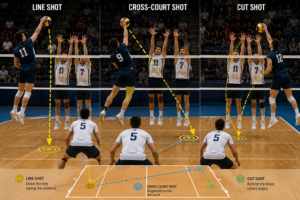
Effective attacking is not only about how hard a player hits the ball but also where the ball is placed. Line shots, cross-court shots and cut shots are common attacking options that allow hitters to target different areas of the opponent’s court and exploit defensive weaknesses in a team.
- A line shot is an attack directed along the sideline on the hitter’s side of the court. Because the ball travels on a relatively straight path, line shots can be effective when blockers take away cross-court angles or when defenders leave the sideline exposed.
- These attacks often require precision and good ball control to keep the ball in bounds.
- A cross-court shot is hit diagonally across the court toward the opposite corner. This is one of the most frequently used attacking options because it provides a larger target area and can create difficult angles for defenders.
- Depending on the hitter’s position, a cross-court attack can be delivered with power or placed strategically into open space.
- A cut shot is a more advanced attack that uses a sharp angle to send the ball across the net and toward a short area of the court. These shots are often used to avoid blockers and catch defenders off guard.
- Because of the angle involved, cut shots require excellent timing, wrist control and accuracy.
- The ability to use all three attacking options makes a hitter more versatile and unpredictable. Rather than relying on the same shot every time, skilled players adjust their attack based on the position of the block and defense.
By varying shot direction, hitters can create scoring opportunities and make it more difficult for opponents to anticipate your team’s next move.
Down Balls and Free Balls: Controlled Offensive Hits
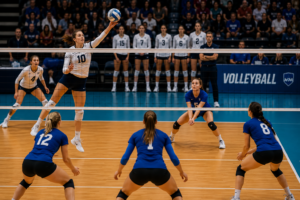
Not every attacking opportunity allows for a powerful spike during a volleyball match. In situations where a player cannot execute a full attack, down balls and free balls provide controlled alternatives that help maintain pressure on the opposing team while reducing the risk of errors.
- A down ball is an attack hit delivered with a controlled downward motion rather than a full-power spike. This often occurs when the set is too low, too far off the net or when blockers make an aggressive attack difficult.
- Although down balls generally travel with less speed, they can still be effective when placed strategically into open areas of the court.
- A free ball is a controlled return sent over the net when a team is unable to organize an offensive attack. Instead of attempting a risky hit, players send the ball deep into the opponent’s court to keep the rally alive and allow them time to reset their defensive positions in place.
- Free balls are commonly used after difficult passes, emergency plays or out-of-position situations.
- Because down balls and free balls are usually easier to defend than spikes, placement becomes especially important. Players should aim for areas that force the opposing team out of position or make it more difficult for them to run their preferred offensive play.
- While these contacts may not seem as aggressive as other types of hits, they play an important role in overall match strategy. Smart players understand that maintaining ball control and making good decisions will be just as valuable as attempting a powerful attack.
When used effectively, down balls and free balls help teams stay competitive, extend rallies and create effective scoring opportunities.
Back-Row Attacks and Advanced Hitting Variations
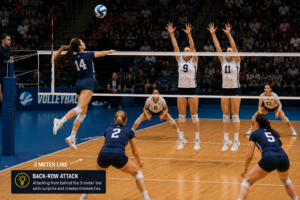
As players develop their skills and teams adopt more sophisticated offensive methods, additional attacking variations become available beyond traditional front-row hits. Back-row attacks and other advanced hitting variations add versatility to an offense and make it more difficult for opponents to predict where the next attack will come from.
- A back-row attack occurs when a player positioned behind the attack line jumps and hits the ball before landing. These attacks allow teams to involve more hitters in their offense and create additional scoring opportunities.
- Common examples include attacks from the left-back, middle-back and right-back positions. To do it within the rules of volleyball, the attacker must take off from behind the attack line when contacting the ball above the height of the net.
- Advanced hitting variations often involve unique approaches, timing patterns or strategic shot selections designed to challenge blockers and defenders. Some attacks emphasize speed, while others focus on creating unusual angles or exploiting defensive gaps.
- These variations are frequently used in professional and competitive volleyball matches where players possess greater technical skills of the sport and significant court awareness.
- The effectiveness of these offensive variations depends on strong communication between setters and hitters. Precise timing, accurate sets and a clear understanding of offensive methods are essential for successful execution.
- Because these attacks can come from multiple angles/positions on the court, they often force blockers to make quick decisions and cover a wider area.
Although back-row attacks and advanced hitting variations require practice and coordination, they can significantly strengthen a team’s offensive capabilities. By expanding the number of available attacking variations, teams become less predictable and better equipped to score against organized defenses.
How to Choose the Right Type of Hit During a Match
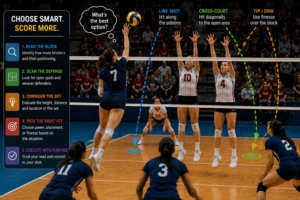
Choosing the right type of hit during a volleyball match requires a combination of court awareness, decision-making and adaptability. Rather than relying on the same attack every time, successful players evaluate the situation and select the option that gives their team the best chance to score.
One of the most important factors to consider is the position of the opposing blockers. If the block is well-formed and takes away a powerful attack, a tip, dink or roll shot may be a better choice.
Similarly, if defenders are positioned deep in the court, a short shot into an open area can be highly effective.
The quality of the set also influences shot selection. A well-placed set may allow for a full-power spike, while an off-target set may require a controlled down ball or off-speed attack.
Players must be able to adjust quickly and make smart decisions based on the ball they receive.
Another key consideration is the defensive positions of the opposing team. Hitters should constantly look for gaps, identify weak spots and vary their attacks to keep defenders guessing.
Mixing line shots, cross-court shots and other attacking variations will make an offense far less predictable.
Ultimately, the best hitters understand that successful attacking is not always about power. The ability to read the game, recognize opportunities and select the most effective hit for the situation is what separates skilled attackers from predictable ones.
Developing this decision-making ability will greatly improve a player’s overall offensive performance on the court.
FAQs on Types of Hits in Volleyball
Which Type of Hit is Best for Beginner Volleyball Players to Learn First?
The spike is often the first offensive hit beginners focus on learning. However, players should also practice tips, roll shots and controlled attacks to develop a more complete offensive skill set and become less predictable during matches.
Can Back-Row Players Perform Attack Hits in Volleyball?
Yes. Back-row players can attack the ball as long as they follow the rules governing back-row attacks. Typically, they must take off from behind the attack line when contacting the ball above the height of the net.
Why Do Volleyball Players Use Soft Shots Instead of Always Spiking the Ball?
Soft shots such as tips, dinks and roll shots help players exploit defensive gaps and avoid blockers. Using a variety of attacks keeps opponents guessing and will be more effective than relying solely on powerful spikes.
Conclusion
As an attacking player of your team, mastering the different types of hits in volleyball definitely gives you an advantage over your opponents.
I am sure that through this guide, you got a clear idea on the types of hits in volleyball and how and when to choose each hit to increase the chances of scoring points for your team.
It’s your turn now!
What are your thoughts about this guide?
Would you like to add any tip that helped you master the different types of hits in volleyball?
Kindly share them in the comments section below!
Related Posts
Types of Attacks in Volleyball Every Hitter Should Know
Types of Blocks in Volleyball: A Complete Guide
Types of Volleyball Balls: Here’s What Players Need to Know!
LET’S BE SOCIAL!

I totally agree! One of the keys to volleyball is keeping your opponents guessing. That’s why mixing in soft shots instead of relying on powerful spikes all the time makes so much sense. Sometimes it’s not about hitting the ball harder, it’s about placing it where the other team least expects it.
Hi Clarice, totally agree with your last point and thank you very much for your kind words!
This makes watching volleyball even more fun when you understand what’s happening 💭
Hi Giangi Townsend, I totally agree!
This was really interesting because I never knew there were so many different types of hits in volleyball. I like how you broke everything down without making it feel too technical.
Hi Shakia, so glad to know that you learned something new about volleyball from this post.
I loved learning about the types of hits involved in volleyball. It’s always so much fun to me to watch a game with what I’ve learned from your posts.
Hi Beth, thank you very much and your kind words mean a lot.
This post will be so useful for those who are considering taking up volleyball or who are starting out!
Hi Lucy, thank you very much!
This breakdown of the hitting techniques is incredibly helpful for my friend. I sent them this article, and they said I rock LOL
Hi Mahy, so happy to know that you and your friend found this post helpful.
Your wealth of knowledge of volleyball is astounding! I learn so much from you every time I visit the blog.
Continue to share in this space, your contribution to the sport is so valuable.
Hi Victoria Prasad, thank you so very much! It means a lot!
This was a fun one! I knew spikes and sets, but not the other ones. I honestly thought they were just hitting it however they could. LOL
Hi Claudia, so glad to know that you learned something new about volleyball from this post.
This is a great resource that helps players and viewers understand what’s actually happening on the court. Love this.
Hi Beth, thank you very much!
oh wow, this is so so cool…I really thought there was only one way to hit in volleyball….This is very enlightening, I love it.
Hi Karen, thank you very much!
Great tips for volleyball players of all skill levels! I never realized there were so many different types of hits beyond the traditional spike. Learning when to use tips, roll shots, and off-speed attacks can really make a player more versatile and unpredictable on the court.
Hi Lisa, thank you very much! So glad to know that you learned something new about volleyball from this post. I totally agree with your last point.
Really helpful guide explaining different volleyball hits and how players adjust attacks based on blockers and defense. Learning spikes tips and cross court shots definitely improves decision making and overall offensive performance.
Hi Marie Cris Angeles, thank you very much and I totally agree with your last point.
As always you have given such a great insight into the sport with your knowledge. This is all so useful for players who are starting out!
Hi Yeah Lifestyle, thank you so much!