
Top Volleyball Faults and Violations Players Need to Avoid
You can make mistakes, but you’re not a failure until you start blaming others for those mistakes.
John Wooden
Source: Dear Volleyball.
Wonder of Volleyball is reader supported. Some of the links contained in this post are affiliate links. If you click and purchase through those links, we’ll get a commission at no additional cost to you. Read our full disclaimer here.
Thanks in advance for supporting our work!
What are the top volleyball faults and violations that you should be aware of as a player?
Would you like to know how each volleyball fault and violation explained in this guide will potentially change the momentum of a match?
Keep reading till the end to know all the details!
Almost all volleyball faults and violations from your team will award a point to your opponent and can change the whole proceedings of the match.
In this post, we’ll take a closer look at the top volleyball faults and violations, how to prevent them and perform at your best as a team.
Let’s get started. Shall we?
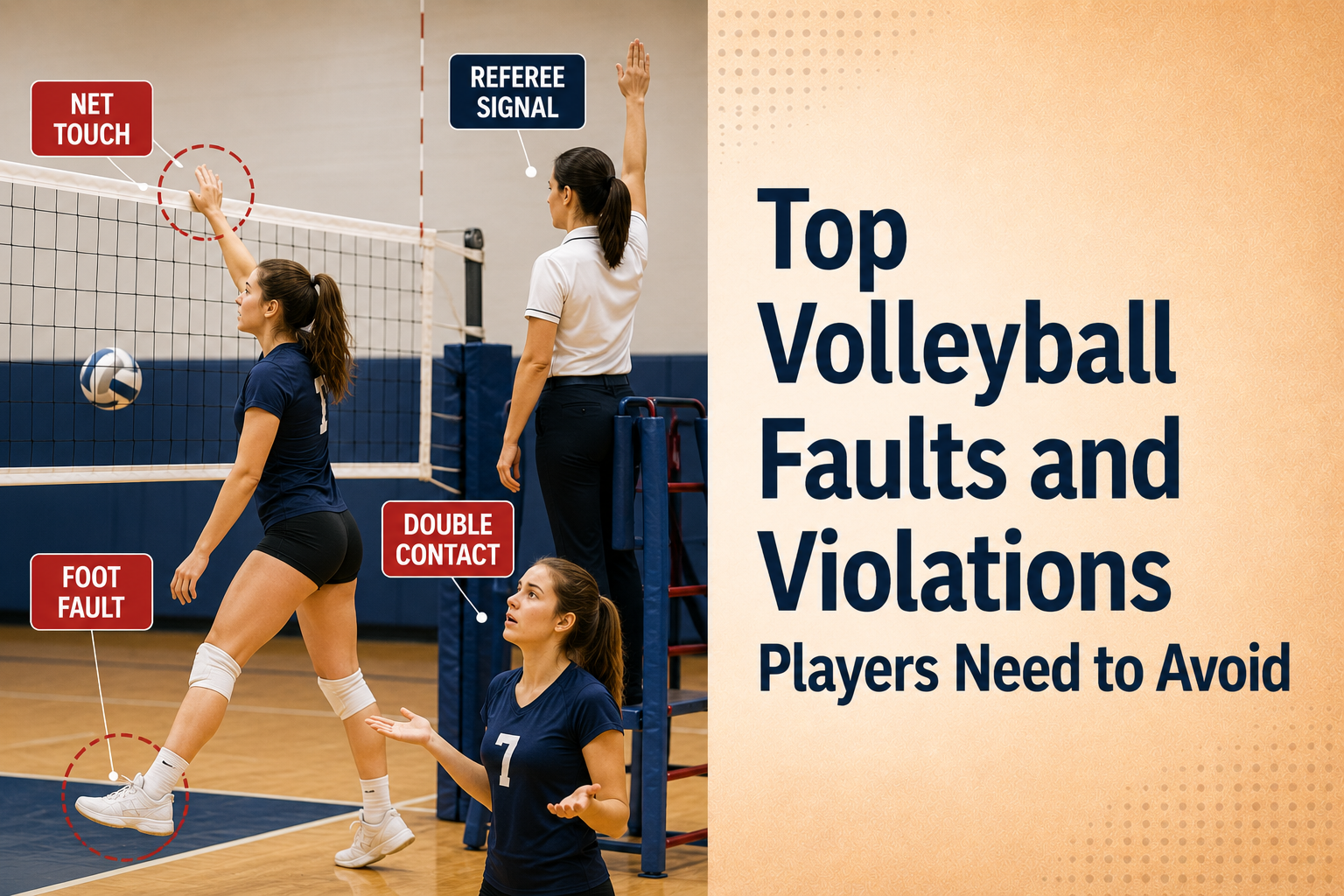
Did you know that faults such as crossing the center line, touching the net, or stepping on the end line during a serve often happen when players become so focused on the ball that they lose awareness of their surroundings? Great players learn to track both the ball and their position on the court at the same time.
Volleyball Faults and Violations Players Need to Avoid
What Are Faults and Violations in Volleyball?

In volleyball, faults and violations are mistakes that break the rules of the game and result in a point or side-out for the opposing team. These errors can happen during serving, attacking, blocking, rotating or handling the ball.
Understanding these rules is important because even small mistakes can quickly affect the momentum of a match.
- Faults are usually individual mistakes made by a player, such as stepping on the end line during a serve, touching the net or making illegal ball contact.
- Violations can also involve team-related errors like incorrect rotation positions or too many touches on one side of the court. Referees carefully watch for these actions to make sure the match is played fairly and safely.
- Being aware of common volleyball faults and violations helps build better habits and improves overall match awareness. Players who understand the rules are often more confident, make smarter decisions during rallies and avoid giving away unnecessary points.
While mistakes are a normal part of learning volleyball, reducing avoidable faults can greatly improve both individual and team performance during matches.
Service Faults Players Commonly Make During a Match

Service faults are some of the most common mistakes players make during a volleyball match.
Since every rally starts with a serve, even a small serving error can immediately give the opposing team a point or the chance to regain possession of the ball.
- One common service fault happens when a player steps on or crosses the end line before contacting the ball. This is known as a foot fault and results in an automatic loss of the serve.
- Another frequent mistake is serving the ball out of bounds, either beyond the sidelines or past the back line of the opponent’s court.
- Players may also commit a service fault by failing to serve within the allowed time after the referee’s whistle.
- In some situations, the server may strike the ball incorrectly, causing an illegal serve or a complete miss on the contact attempt.
- Serving out of rotation is another important violation that teams must avoid. If the wrong player serves when it is not their turn in the rotation order, the referee will award a point to the opposing team.
Learning proper serving techniques, maintaining focus and practicing consistent routines can help players reduce these mistakes and become more reliable servers during matches.
Net Violations and Why They Are Penalized
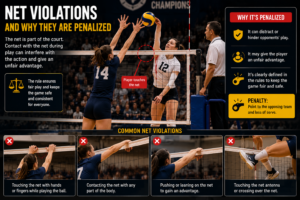
Net violations occur when a player illegally touches the net during a rally. These faults are closely monitored by referees because they can interfere with fair play and create an unsafe situation near the court.
In most cases, a team loses the rally immediately when a net violation is called.
- One of the most common net violations happens when a player touches the top band of the net while attempting to block, spike or follow through on an attack.
- Even slight contact with the net during active play can result in a penalty if it affects the rally. Players must learn to control their body movements around the net to avoid unnecessary mistakes.
- Another violation can occur when a player reaches under or across the net in a way that interferes with the opposing team’s ability to play the ball. Although some crossing movements are allowed, interfering with an opponent is considered illegal.
- Net violations are penalized because volleyball requires both teams to compete fairly on their own side of the court. These rules also help protect players from dangerous collisions and injuries during fast-paced rallies near the net.
Improving footwork, balance and body control will help players avoid net violations and perform more confidently during offensive and defensive plays of a match.
Foot Faults in Volleyball and How to Avoid Them
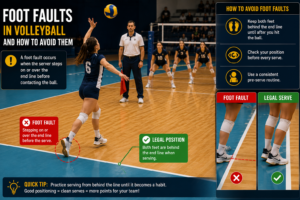
Foot faults occur when a player steps on or crosses a boundary line in a way that violates the rules of volleyball. While they may seem like minor mistakes, foot faults will result in an immediate point or side-out for the opposing team.
- The most common foot fault happens during a serve. Players must remain behind the end line until they make contact with the ball. If any part of the foot touches or crosses the line before contact, the referee will call a fault and award the rally to the opposing team.
- Foot faults can also occur near the center line beneath the net. Players are generally allowed to step on the center line as long as they do not completely cross it or interfere with an opponent’s movement. However, crossing too far into the opponent’s court can lead to a violation and potentially create a safety risk.
- Fortunately, foot faults are often preventable with proper awareness and practice. Servers should develop a consistent serving routine and pay attention to their starting position before each serve. During rallies, players should maintain balance and body control, especially when moving quickly near the net.
By improving court awareness and practicing disciplined footwork, players will avoid unnecessary penalties and perform more confidently during matches.
Rotation Violations Every Player Should Understand
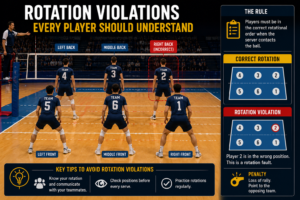
Rotation violations take place when players are not in their correct positions on the court at the moment the ball is served. Because volleyball follows a specific rotational order, every player must maintain the proper serving sequence and court position until the serve has been contacted.
- A common rotation violation happens when players overlap incorrectly before the serve. For example, a front-row player may be positioned behind a back-row teammate, or a player may stand too far left or right of their designated position. Even if the overlap is only slight, the referee may still call a violation.
- Another frequent mistake occurs when the wrong player serves the ball. Teams must follow the established serving order throughout the set. If a player serves out of turn, the opposing team is awarded a point, and the serving order is corrected.
- Rotation violations are penalized because they help maintain fairness and ensure teams do not gain an unfair positional advantage. These rules also preserve the structure and strategy that make volleyball unique.
- The best way to avoid rotation violations is through communication and awareness. Players should regularly check their positions before each serve and confirm the rotation with teammates when necessary.
- Coaches often use practice drills and rotation charts to help players become more comfortable with the rotations rules of volleyball.
Through understanding rotation-based rules and staying attentive on the court, players will avoid unnecessary penalties and help their team play more efficiently.
Must’ve Gear for Volleyball Players
Double Contacts and Lift Calls
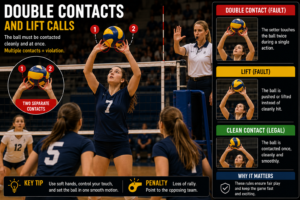
Double contacts and lift calls are among the most commonly misunderstood volleyball violations among players. Both involve illegal ball handling and will result in the opposing team being awarded the rally.
- A double contact occurs when a player touches the ball twice in succession during a single attempt to play it. This often happens when setting the ball and the contact is uneven, causing the ball to leave one hand before the other. However, a double contact is generally not called on a team’s first contact after an opponent’s attack, provided the ball is played in one continuous action.
- A lift, sometimes called a carry, occurs when a player catches, throws, or holds the ball instead of making a clean contact. The ball should rebound quickly off the player’s hands or arms. If the referee believes the ball was controlled for too long, a lift violation may be called.
- These rules exist to keep the game flowing smoothly and ensure that players use proper volleyball techniques. While double contacts and lifts are often unintentional, they can disrupt fair play and provide an unfair advantage.
Players can reduce these violations by practicing correct passing and setting fundamentals. Developing soft hands, proper body positioning and consistent ball control will make legal contacts easier and help build confidence during matches.
Back Row Attack and Blocking Violations
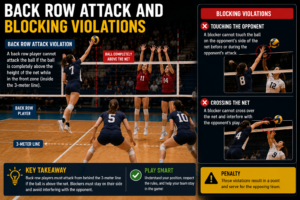
Back row attack and blocking violations occur when back-row players perform actions that are restricted by volleyball rules. These rules help maintain the balance between offensive and defensive roles on the court.
- A back-row attack violation takes place when a back-row player jumps from in front of the attack line and contacts the ball completely above the height of the net while sending it toward the opponent’s court. Back-row players are allowed to attack, but they must take off from behind the attack line if the ball is above net height at the moment of contact.
- Blocking violations can also involve back-row players. Unlike front-row players, back-row players are not permitted to participate in a block. If a back-row player touches the ball while attempting to block at the net, the referee will call a violation. This rule applies even if the contact seems minor.
- The libero has additional restrictions. In most volleyball rule sets, the libero cannot complete an attack hit when the ball is entirely above the net, nor can they attempt or complete a block.
- These violations are penalized because they preserve the unique responsibilities of each position and ensure fair competition between teams on the court. Without these rules, teams could gain an unfair advantage by using back-row players in ways that are not intended within the structure of volleyball.
Players can avoid these violations by understanding their position-based responsibilities and staying aware of their location on the court during rallies.
Ball Handling Mistakes That Often Lead to Penalties
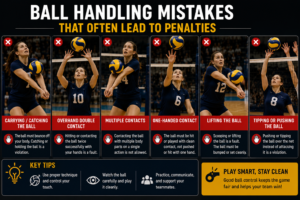
Ball handling mistakes are common volleyball errors that occur when a player contacts the ball in a way that violates the rules. These mistakes often lead to penalties and will quickly shift momentum in favor of the opposing team.
- One of the most frequent ball handling violations is a double contact, where a player touches the ball twice during a single play.
- Another common mistake is a lift or carry, which occurs when the ball is caught, held or thrown instead of being cleanly contacted. Referees may call these violations when the ball remains in contact with a player’s hands or arms for too long.
- Players will also be penalized for making illegal contacts while setting. Uneven hand contact or poor technique may cause the ball to spin excessively, leading officials to judge the play as a double contact. These calls are particularly common when players attempt difficult sets without proper positioning.
- Many ball handling mistakes happen because players are rushed, off balance or using incorrect technique. While some violations can be difficult to judge, referees are responsible for ensuring that the ball is played cleanly and according to the rules.
The best way to reduce ball handling errors is through consistent practice of passing, setting and defensive skills. Proper footwork, body control and hand positioning help players make cleaner contacts and improve overall ball control during matches.
As technique improves, these violations tend to become less frequent.
Common Team Violations That Can Cost Important Points
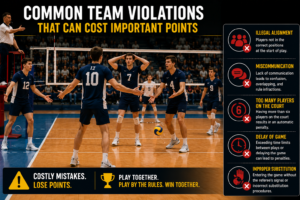
While many volleyball faults are committed by individual players, some violations involve the entire team and will result in the loss of important points. These team violations are often caused by miscommunication, lack of awareness or failure to follow the rules correctly.
- One of the most common team violations is an incorrect rotation. If players are not in their proper positions when the ball is served, the referee can call a rotation violation and award a point to the opposing team. Serving out of order is another mistake that falls into this category.
- Teams can also be penalized for exceeding the maximum of three contacts before returning the ball over the net. If a fourth contact occurs, the rally ends immediately in favor of the opposing team.
- Similarly, if two teammates fail to communicate and allow the ball to drop untouched, the team loses the point.
- Other violations may include delay in serving and exceeding the allocated time, illegal substitutions or repeated misconduct that results in team penalties. Although these mistakes may not happen as frequently, they will be costly during close matches.
Most team violations are preventable through effective communication, proper organization and a solid understanding of the rules. Players should stay aware of their positions, communicate clearly during rallies and pay attention to instructions from coaches and officials.
Teams that minimize avoidable violations often perform more consistently and place themselves in a better position to win important points throughout a match.
Tips for Avoiding Faults and Playing Smarter
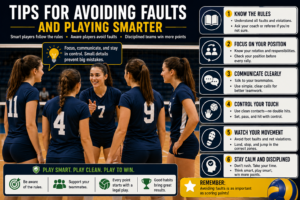
Avoiding faults and violations is an important part of becoming a smarter and more reliable volleyball player. While mistakes are a natural part of learning the sport, many penalties can be prevented through preparation, awareness and consistent practice.
- One of the best ways to reduce faults is to develop strong fundamentals. Proper serving, passing, setting and footwork techniques help players make cleaner plays and avoid common violations such as foot faults, double contacts and lifts. Regular practice also improves muscle memory, making correct movements more automatic during matches.
- Court awareness is equally important. Players should know their positions, understand rotation rules and remain aware of the attack line, center line and net during rallies. Paying attention to these details will significantly reduce avoidable mistakes.
- Communication is another key factor. Teammates who communicate clearly are less likely to commit rotation errors, exceed the three-contact limit or allow confusion during plays. Simple calls and reminders can help keep everyone organized and focused.
- Finally, learning the rules of volleyball is one of the smartest investments a player will make. Understanding why violations occur allows players to recognize risky situations and make better decisions under pressure.
The most successful players are not always the ones who make the most spectacular plays. Often, they are the players who consistently avoid unnecessary mistakes, play within the rules and help their team maintain control throughout the match.
FAQs on Volleyball Faults and Violations Players Need to Avoid
Do Volleyball Faults and Violations Always Result in a Point for the Opposing Team?
In most cases, yes. When a fault or violation is called, the opposing team is typically awarded the rally, which results in a point under the rally-scoring system used in modern volleyball.
Are Some Volleyball Violations Judged Differently at Beginner and Professional Levels?
The rules remain the same, but referees at beginner levels may focus more on player development and overall match flow. At higher levels, violations are usually enforced more strictly and consistently.
Why is it important for players to learn volleyball rules in addition to skills?
Understanding the rules helps players make better decisions, avoid unnecessary penalties and play with greater confidence. Strong knowledge in volleyball rules also improves teamwork, positioning and overall match awareness.
Conclusion
Volleyball faults and violations will not only change the whole momentum of a match, they have the potential to sap the morale of the team. In a closely fought match, a small fault or a violation could be the deciding factor between winning and losing.
I am sure that from this detailed guide, you have a clear idea on what are the top volleyball faults and violations, in which way each fault and violation occur, how to avoid them and perform at your best in a match.
It’s your turn.
What are your thoughts about this guide?
Would you like to add volleyball faults and violations that you know?
Share them away in the comments section below!
Related Posts
Types of Blocks in Volleyball: A Complete Guide
Types of Attacks in Volleyball Every Hitter Should Know
Basic Rules of Volleyball: A Complete Guide for Beginner Players
LET’S BE SOCIAL!

I’m really happy that you’re writing, because people are lucky to learn from a volleyball player.
Hi Nursery Rhymes Girl, thank you very much! Means a lot to read that!
I love learning all the rules of the game. It makes it so much more fun to watch when you understand it.
Hi Jenny, thank you so much!
Great post! Volleyball looks simple from the sidelines, but these little rules make a big difference.
Hi Rita, thanks a lot. Glad to know that you learned something new about volleyball from this post.
It is so important to know what can get you in trouble when playing. Thank you for explaining these faults and violations so simply.
Hi Jupiter Hadley, glad to know that you found this post helpful.
Great overview so far! I think one thing that makes volleyball so interesting is how quickly a single fault can change the momentum of a game. New players often focus on serving, passing, and hitting, but understanding violations like net touches, foot faults, and center line violations is just as important. Avoiding simple mistakes can save a lot of points over the course of a match. Good info!
Hi Ann, thank you very much! I completely agree with all of your points!
I had absolutely no idea there were so many things you could get faults for in Volleyball. Definitely useful to know!
Hi Claire Mac, so glad to know that you learned something new about volleyball from this post.
Great breakdown of the rules and common mistakes players should avoid. Whether you’re new to volleyball or have been playing for years, understanding these faults and violations can make a huge difference in your performance on the court. The tips for avoiding penalties and improving match awareness are especially helpful.
Hi Lisa, thank you very much! I completely agree with your second point!
I love volleyball, and I played it in school.
The section on rotation violations is particularly valuable, as it is one of those areas where even experienced players can get caught out if communication breaks down. The point about double contacts being allowed on a first contact after an opponent’s attack is a nuance that casual players often don’t know, so it is good to see it addressed clearly. A thorough and well-structured guide for anyone wanting to understand the rules more deeply.
Hi Meeta, thank you very much! So happy to know that you love volleyball and played it during your school days.
So important to know these early on to build habits to avoid them. I’d never have thought touching the top of the net was a violation x
Hi Rhian Scammell, I completely agree with your first point and so glad to know that you learned something new about volleyball from this post.
Learning these rules can really improve performance. Small mistakes can quickly change the momentum of matches.
Hi Marie Cris Angeles, I totally agree with your points!
This is such a useful list to have for anybody new to volleyball. Mistakes happen obviously but it is good to know how these can affect the match.
Hi Yeah Lifestyle, glad to know that you found this post helpful.
I didn’t know a lot of these were actually violations like touching the top of the net. Wow…Such a beautiful sport.
Hi Karen, glad to know that you learned something new about volleyball from this post.
This was such a great one. I’ve seen violations be called before, but I had no idea why or what they were.
Hi Beth, so glad to know that you learned something new about volleyball from this post.
No matter what sport you play you always need to know the rules and what is allowed and what is not allowed. They are just as important as the moves
Hi Samantha Donnelly, I totally agree with your points!
Volleyball players must remember when they should pass it. They can lose the game by making common mistakes.
Hi Moni Lodha, I agree.